I am a Christian, a Texan, a husband and father. This blog is a collection of things that interest me.
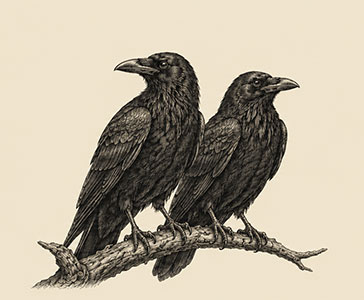
The blog takes its name from Huginn and Muninn, the ravens of Norse myth whose names mean Thought and Memory, a fitting emblem for a site about history, faith, and the memory of Western civilization.
What I believe
I’m a Reformed Protestant with a high view of Scripture and of God’s sovereignty. I don’t see Christianity as a Sunday activity or a private feeling, but as a comprehensive way of understanding family, politics, history, and character, a civilization-forming faith rather than merely a source of personal comfort.
How I think politically
I’d call myself a paleoconservative with libertarian instincts. I distrust concentrated power wherever it gathers, capitals, corporations, bureaucracies, international bodies, and I’m skeptical of grand, top-down projects, left or right. I prefer government that is limited, constitutional, local, and restrained, and I value national sovereignty, federalism, and the preservation of inherited institutions over ideological abstractions.
Yet I’ll be honest about the ideal beneath the hedge. I would trade all of it in a heartbeat for a genuinely Christian monarchy, a king who cared more for his people and his nation than for himself. Imagine an Aragorn, a Caspian, a Tirian: a sovereign who rules as servant and shield rather than master, who bends the knee to God before his subjects bend the knee to him. Such kings are rare, and the constitutional restraints I prize are largely what free men build when they cannot count on one. But the restraints are the second-best thing. The king who loves God and his people is the first.
History has occasionally come close, an Alfred the Great defending and then rebuilding his people, a Gustavus Adolphus standing as a shield for the Protestant cause, though only ever come close. No crown has sat on a spotless head. That is rather the point: the ideal is worth naming precisely because it is so seldom met.
Why continuity matters
I’m a traditionalist by temperament. I think civilizations inherit hard-won wisdom, and that we ignore that inheritance at our peril. Newer isn’t automatically better; the more useful question is usually what has endured for centuries, and why.
How I read history
Not as a ledger of dates, but through character, leadership, and providence. I’m persuaded that exceptional individuals, acting with courage and conviction, genuinely bend the course of civilizations, that history is carried, in no small part, by men who stood for principles larger than themselves.
What I read and why
I’m interested in the ideas that shape civilizations, which makes for wide reading, the Reformed tradition, Civil War history, classical education, Stoic philosophy, the psychology of archetypes, and more. Studying a thinker isn’t the same as agreeing with him; I’m after the foundations, not slogans. I tend to think in systems, tracing first principles rather than arguing isolated issues, more like an architect than a technician.
What I value
Competence, craftsmanship, and quiet responsibility, people who master their work, keep their word, and leave things better than they found them. Faithfulness impresses me more than flash. And I’ll admit to a dislike of being managed: I’d rather see people free to govern themselves responsibly than tended by experts who are sure they know better.
What I’m really after
Formation. I’m less interested in winning today’s argument than in asking what produces healthy people and institutions over generations, which is why family, church, education, liturgy, and cultural memory keep drawing me back. Culture shapes politics more than politics shapes culture. Faced with almost any question, my instinct is to ask the longer one:
- Does this strengthen families?
- Does it preserve liberty?
- Does it reinforce Christian virtue?
- Does it encourage responsible self-government?
- Will it leave our civilization stronger a hundred years from now?
If I had to put the whole thing in a sentence: free and virtuous people, formed by Christianity, strong families, local communities, and enduring traditions, are the real foundation of a flourishing civilization, and preserving those foundations matters more than chasing every new trend.