Tag: America

  • USS Enterprise

    24 September 1960, USS Enterprise (CVN-65) the first nuclear powered aircraft carrier, is launched.

    She was the world’s first nuclear-powered aircraft carrier and the eighth United States naval vessel to bear the name. Like her predecessor of World War II fame, she is nicknamed “Big E”. At 1,123 ft (342 m),she is the longest naval vessel ever built. Her 93,284-long-ton (94,781 tonnes) displacement ranked her as the 12th-heaviest supercarrier, after the 10 carriers of the Nimitz class and the USS Gerald R. Ford. Enterprise had a crew of some 4,600 service members.

    The only ship of her class, Enterprise was, at the time of inactivation, the third-oldest commissioned vessel in the United States Navy after the wooden-hulled USS Constitution and USS Pueblo. – wikipedia

    040614-N-0119G-020 Atlantic Ocean (June 14, 2004) — The nuclear powered aircraft carrier USS Enterprise (CVN 65) surges through the water of the Atlantic Ocean. Enterprise is one of seven aircraft carriers involved in Summer Pulse 2004. Summer Pulse 2004 is the simultaneous deployment of seven aircraft carrier strike groups (CSGs), demonstrating the ability of the Navy to provide credible combat power across the globe, in five theaters with other U.S., allied, and coalition military forces. Summer Pulse is the Navy’s first deployment under its new Fleet Readiness Plan (FRP). The strike group will conduct a scheduled training exercise followed by overseas Pulse operations. Official US Navy photo by Photographer’s Mate Airman Rob Gaston. Image released by LT K.R. Stephens, PAO CVN 65.
  • I have not yet begun to fight!

    23 September 1779; John Paul Jones’ Bon Homme Richard defeats HMS Serepis. I have not yet begun to fight! – John Paul Jones

  • The Star-Spangled Banner

    Francis Scott Key was inspired on 14 September 1814 to write the “Star-Spangled Banner” while watching the bombarding of the American forces at Fort McHenry during the Battle of Baltimore on the night of September 13–14, 1814.US National Anthem by the Academy Choirs – https://youtu.be/9ETrr-XHBjE

    God bless America!

  • Small step

    20 June, 1970, the first humans landed on the moon; Americans Neil Armstrong and Buzz Aldrin.


  • ‘Do Not Go Gentle into that Good Night’

    Dylan Thomas reciting his villanelle ‘Do Not Go Gentle into that Good Night’

    Do not go gentle into that good night,
    Old age should burn and rave at close of day;
    Rage, rage against the dying of the light.

    Though wise men at their end know dark is right,
    Because their words had forked no lightning they
    Do not go gentle into that good night.

    Good men, the last wave by, crying how bright
    Their frail deeds might have danced in a green bay,
    Rage, rage against the dying of the light.

    Wild men who caught and sang the sun in flight,
    And learn, too late, they grieved it on its way,
    Do not go gentle into that good night.

    Grave men, near death, who see with blinding sight
    Blind eyes could blaze like meteors and be gay,
    Rage, rage against the dying of the light.

    And you, my father, there on the sad height,
    Curse, bless, me now with your fierce tears, I pray.
    Do not go gentle into that good night.
    Rage, rage against the dying of the light.


  • Last orders

    April 10, 1865 at Appomattox Court, Va, General Robert E. Lee issues his last orders to the Army of Northern Virginia.

    “The gentleman does not needlessly and unnecessarily remind an offender of a wrong he may have committed against him. He can not only forgive; he can forget; and he strives for that nobleness of self and mildness of character which imparts sufficient strength to let the past be but the past” – Robert E Lee

  • Storm in the Mountains, c. 1870 – Albert Bierstadt

    > Albert Bierstadt (January 7, 1830 – February 18, 1902) was a German-born American painter best known for his lavish, sweeping landscapes of the American West. To paint the scenes, Bierstadt joined several journeys of the Westward Expansion. Though not the first artist to record these sites, Bierstadt was the foremost painter of these scenes for the remainder of the 19th century.


    https://upload.wikimedia.org/wikipedia/commons/6/6a/HRSOA_AlbertBierstadt-Storm_in_the_Mountains.jpg

    > Born in Germany, Bierstadt was brought to the United States at the age of one by his parents. He later returned to study painting for several years in Düsseldorf. He became part of the Hudson River School in New York, an informal group of like-minded painters who started painting along this scenic river. Their style was based on carefully detailed paintings with romantic, almost glowing lighting, sometimes called luminism. An important interpreter of the western landscape, Bierstadt, along with Thomas Moran, is also grouped with the Rocky Mountain School.

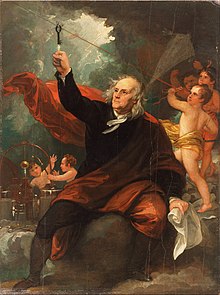
  • Benjamin Franklin Drawing Electricity from the Sky by Benjamin West

    Benjamin West PRA (October 10, 1738 – March 11, 1820) was an Anglo-American painter of historical scenes around and after the time of the American War of Independence. He was the second president of the Royal Academy in London, serving from 1792 to 1805 and 1806 to 1820. He was offered a knighthood by the British Crown, but declined it, believing that he should instead be made a peer. He said that “Art is the representation of human beauty, ideally perfect in design, graceful and noble in attitude.” viahttps://en.wikipedia.org/wiki/Benjamin_West

  • THIS DAY IN HISTORY – George Washington gives first presidential inaugural address – 1789

    Via History.com

    large_di-0707-2_m-4535_march-to-trenton-web
    Hour of Victory, by Edward Percy Moran, portrays Washington and his troops marching towards Trenton (Mount Vernon Ladies’ Association)

    On this day in 1789, George Washington is sworn in as the first American president and delivers the first inaugural speech at Federal Hall in New York City. Elements of the ceremony set tradition; presidential inaugurations have deviated little in the two centuries since Washington’s inauguration.

    In front of 10,000 spectators, Washington appeared in a plain brown broadcloth suit holding a ceremonial army sword. At 6′ 3, Washington presented an impressive and solemn figure as he took the oath of office standing on the second balcony of Federal Hall. With Vice President John Adams standing beside him, Washington repeated the words prompted by Chancellor Robert R. Livingston, kissed the bible and then went to the Senate chamber to deliver his inaugural address.

    Observers noted that Washington appeared as if he would have preferred facing cannon and musket fire to taking the political helm of the country. He fidgeted, with his hand in one pocket, and spoke in a low, sometimes inaudible voice while he reiterated the mixed emotions of anxiety and honor he felt in assuming the role of president. For the most part, his address consisted of generalities, but he directly addressed the need for a strong Constitution and Bill of Rights and frequently emphasized the public good. He told the House of Representatives that he declined to be paid beyond such actual expenditures as the public good may be thought to require. In deference to the power of Congress, Washington promised to give way to my entire confidence in your discernment and pursuit of the public good.

    After delivering his address, Washington walked up Broadway with a group of legislators and local political leaders to pray at St. Paul’s Chapel. Later, he made the humble and astute observation that his presidency, and the nation itself, was an experiment.