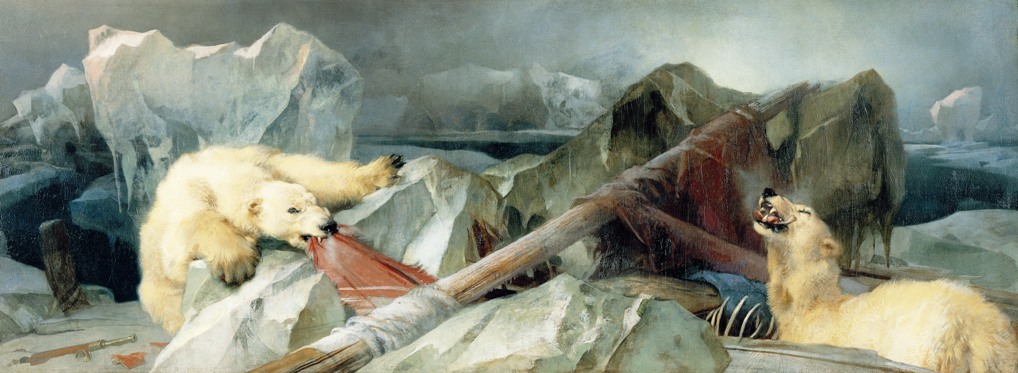
Man Proposes, God Disposes is an 1864 oil-on-canvas painting by Edwin Landseer. The work was inspired by the search for Franklin’s lost expedition which disappeared in the Arctic after 1845. The painting is in the collection of Royal Holloway, University of London, and is the subject of superstitious urban myth that the painting is haunted. https://en.wikipedia.org/wiki/Man_Proposes,_God_Disposes
Isle of the Dead (German: Die Toteninsel) is the best-known painting of Swiss Symbolist artist Arnold Böcklin (1827–1901). Prints were very popular in central Europe in the early 20th century—Vladimir Nabokov observed in his novel Despair that they could be “found in every Berlin home”. (Wikipedia)
John Gast (21 December 1842, Berlin, Prussia – 26 July 1896, Brooklyn. New York), was a Prussian-born painter, printer and lithographer who lived and worked most of his life in Brooklyn, New York. He is most famous for painting American Progress, an allegory of Manifest Destiny that was widely disseminated in chromolithographic prints. Other than that, little is known about him. – Wikipedia
Jacob Wrestling with the Angel – Doré, Gustave (1832-83). The most popular and successful French book illustrator of the mid 19th century. Doré became very widely known for his illustrations to such books as Dante’s Inferno (1861), Don Quixote (1862), and the Bible (1866)
Diogenes of Sinope (/daɪˈɒdʒəˌniːz/; Greek: Διογένης ὁ Σινωπεύς, Diogenēs ho Sinōpeus) was a Greek philosopher and one of the founders of Cynic philosophy. Also known as Diogenes the Cynic (Ancient Greek: Διογένης ὁ Κυνικός, Diogenēs ho Kunikos), he was born in Sinope (modern-day Sinop, Turkey), an Ionian colony on the Black Sea, in 412 or 404 BCE and died at Corinth in 323 BCE. via Wikipedia https://en.wikipedia.org/wiki/Diogenes
Diogenes and Alexander
It was in Corinth that a meeting between Alexander the Great and Diogenes is supposed to have taken place. The accounts of Plutarch and Diogenes Laërtius recount that they exchanged only a few words: while Diogenes was relaxing in the sunlight in the morning, Alexander, thrilled to meet the famous philosopher, asked if there was any favour he might do for him. Diogenes replied, “Yes, stand out of my sunlight”. Alexander then declared, “If I were not Alexander, then I should wish to be Diogenes.” In another account of the conversation, Alexander found the philosopher looking attentively at a pile of human bones. Diogenes explained, “I am searching for the bones of your father but cannot distinguish them from those of a slave.”
Death
There are conflicting accounts of Diogenes’s death. He is alleged variously to have held his breath; to have become ill from eating raw octopus; or to have suffered an infected dog bite. When asked how he wished to be buried, he left instructions to be thrown outside the city wall so wild animals could feast on his body. When asked if he minded this, he said, “Not at all, as long as you provide me with a stick to chase the creatures away!” When asked how he could use the stick since he would lack awareness, he replied “If I lack awareness, then why should I care what happens to me when I am dead?” At the end, Diogenes made fun of people’s excessive concern with the “proper” treatment of the dead. The Corinthians erected to his memory a pillar on which rested a dog of Parian marble.
Jean-Léon Gérôme (11 May 1824 – 10 January 1904) was a French painter and sculptor in the style now known as Academicism. The range of his oeuvre included historical painting, Greek mythology, Orientalism, portraits and other subjects, bringing the Academic painting tradition to an artistic climax. He is considered one of the most important painters from this academic period, and in addition to being a painter, he was also a teacher with a long list of students. via Wikipedia
Henry Tanworth Wells RA (14 December 1828 – 16 January 1903) was an English miniature and portrait painter. He was a member of the Pre-Raphaelite circle though he painted in the academic style.
His most popular painting was Victoria Regina, showing the young princess Victoria hearing the news that she was to accede to the throne.
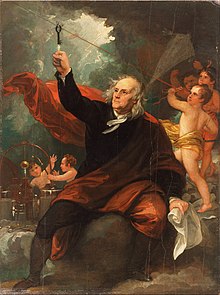
Benjamin West PRA (October 10, 1738 – March 11, 1820) was an Anglo-American painter of historical scenes around and after the time of the American War of Independence. He was the second president of the Royal Academy in London, serving from 1792 to 1805 and 1806 to 1820. He was offered a knighthood by the British Crown, but declined it, believing that he should instead be made a peer. He said that “Art is the representation of human beauty, ideally perfect in design, graceful and noble in attitude.” viahttps://en.wikipedia.org/wiki/Benjamin_West
Pericles’ Funeral Oration, an 1852 painting by Philipp Foltz.
Pericles’ Funeral Oration is a famous speech from Thucydides’ History of the Peloponnesian War. The speech was delivered by Pericles, an eminent Athenian politician, at the end of the first year of the Peloponnesian War (431-404 BC) as a part of the annual public funeral for the war dead.
Philipp Foltz (11 May 1805 – 5 August 1877) was a German historical painter, born at Bingen.