
What actually fell on the fourteenth of July
There were seven men inside.
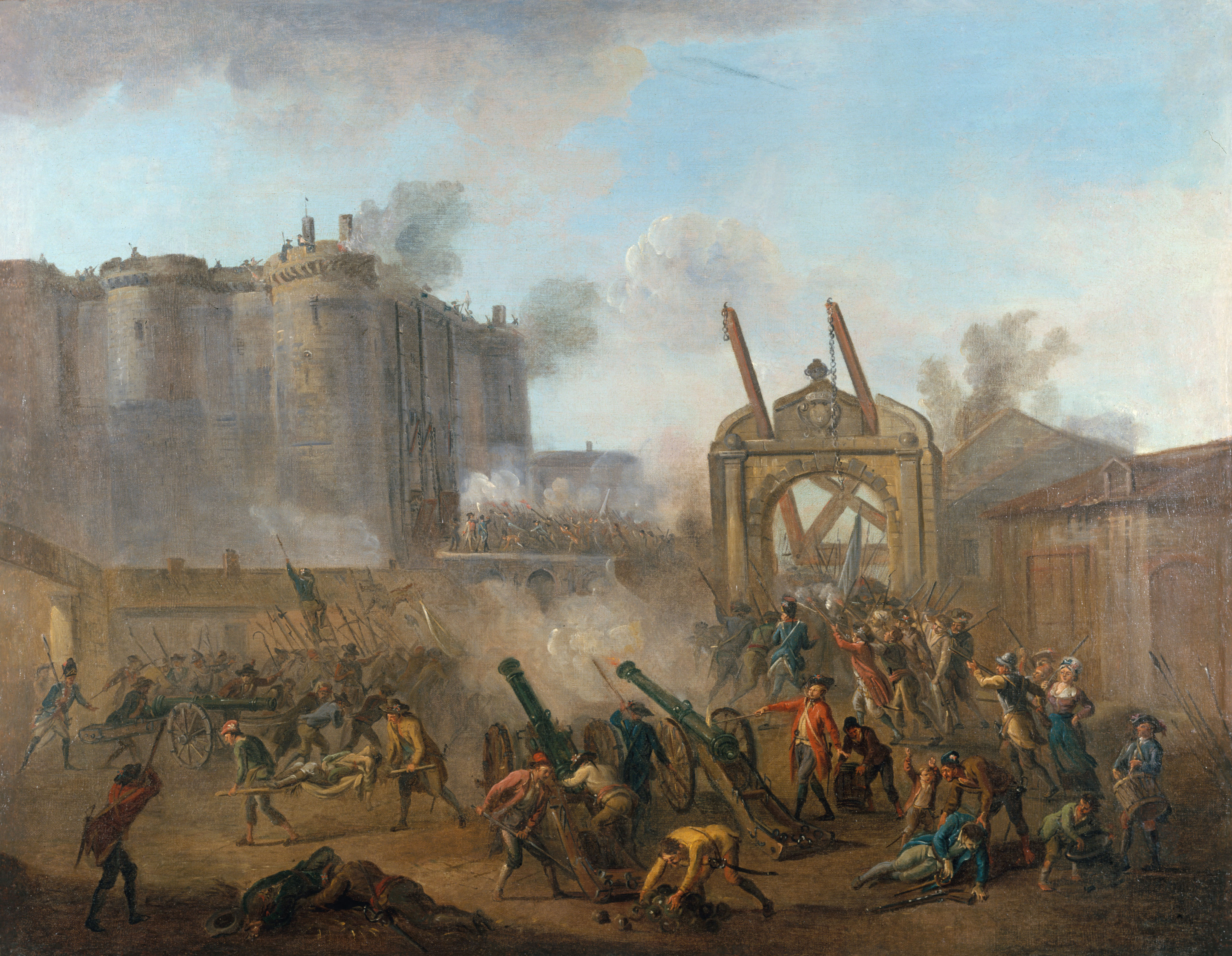
That is the first fact, and it is the one almost nobody mentions. When the crowd came over the walls of the Bastille on the afternoon of 14 July 1789 and entered what generations would remember as the dungeon of tyranny, they liberated four forgers, two men judged insane, and a young aristocrat whose own family had asked the king to confine him. The Marquis de Sade, who would have made a better story, had been transferred ten days earlier after shouting from his window that prisoners were being murdered within.
The crowd had not come principally for the prisoners.
They had come for gunpowder.
That morning, Parisians had taken tens of thousands of muskets from the Invalides. Muskets are of limited use without powder, and the Bastille was believed to contain a large supply. The governor, Bernard-René de Launay, negotiated, hesitated, and eventually lost control of the fortress. After the defenders surrendered, he was dragged toward the Hôtel de Ville, beaten, stabbed, and decapitated. His head was placed on a pike and carried through the streets of Paris.
Seven prisoners and a severed head. That is the ledger of the founding day of the modern world.
The lie in the stones
Here is where I am expected to make a concession.
The Bastille, I am supposed to say, was a wicked place regardless. The lettre de cachet represented arbitrary power. The fortress had to fall, even if the men who felled it behaved like animals. That concession is the toll every conservative is expected to pay before he is permitted to speak about the French Revolution.
I decline to pay it.
Not because arbitrary imprisonment is defensible, but because the popular account of the Bastille is itself a distortion.
The Bastille of 1789 was a nearly empty state prison used largely for troublesome, embarrassing, or politically inconvenient prisoners, many of them men of rank. Conditions varied, and confinement without ordinary public trial was real. But wealthy inmates could occupy furnished rooms, keep books, receive visitors, obtain special meals, and sometimes retain servants. Sade accumulated a wardrobe and a library and spent his last days there bellowing from the window at passers-by.
The fortress had held only a modest number of prisoners for years. The Crown regarded it as obsolete and ruinously expensive. Plans had already been considered for demolishing it and replacing it with a public square.
The revolutionaries did not storm a crowded dungeon filled with the broken victims of royal cruelty. They seized a decaying fortress the king’s own government no longer considered worth preserving, and then made its stones testify against him.
Now look at what replaced it.
Within four years came the Law of Suspects, revolutionary tribunals with scarcely any meaningful avenue of appeal, mass imprisonment, executions by formal sentence, and killings outside the courts. The prisons of France filled with men and women whose guilt often consisted of ancestry, association, religious fidelity, political hesitation, or insufficient enthusiasm.
That is not tyranny giving way to liberty.
It is a limited, decaying, and often arbitrary instrument of royal government giving way to a revolutionary system capable of reaching into every village, parish, family, and conscience in France.
The Bastille held seven men on the morning it fell.
The revolutionary state would learn to imprison hundreds of thousands.
So I do not concede the Bastille.
Let them defend the guillotine first.
Almost nobody saw it
The extraordinary thing is that almost no one understood where the Revolution was going, including many of the friends of order.
Charles James Fox called the fall of the Bastille the greatest event that had ever happened in the world, and the best. Wordsworth later remembered the Revolution’s early days as a dawn in which it was bliss to be alive.
And why not?
The king still reigned. The Church still stood. On the first anniversary of the Bastille, France staged the Fête de la Fédération on the Champ de Mars. Talleyrand celebrated Mass at an altar in the open air. Louis XVI stood before the nation and swore fidelity to the constitutional order. The whole spectacle was presented as reconciliation: a Christian kingdom reformed, made lawful, and restored to unity.
Four months later, Edmund Burke published his Reflections on the Revolution in France and was widely treated as though he had lost his mind.
He had not.
Burke was right before the Revolution had revealed its full character. No Terror had occurred. No king had died. No priest had been drowned in the Loire. The Vendée had not risen. The guillotine had not yet become the symbol of a new political age.
Burke was not reasoning backward from the Revolution’s final crimes.
He was reasoning forward from its premise.

The premise
The Abbé Sieyès had stated the principle plainly: the nation exists prior to everything. The nation is the origin of everything. Its will is always lawful. Its will is the law.
Read that again and ask what could restrain it.
Not the past, because the past possesses no independent authority over the sovereign nation.
Not the Church, because the Church is treated as a corporation existing within the nation and therefore subject to its jurisdiction.
Not the law, because law flows from the national will and cannot stand above the source from which it flows.
Not even God in any practical political sense, because a will declared inherently sovereign and lawful has little need of a judgment beyond itself.
This is the great distinction between 1776 and 1789, and every American who reflexively admires revolutions should sit with it until it becomes uncomfortable.
The men at Philadelphia believed human beings were fallen. They assumed power would corrupt whoever held it. Their answer was to divide authority, enumerate powers, preserve inherited liberties, establish competing institutions, and set ambition against ambition. They built a machine of restraints because they did not trust rulers, assemblies, majorities, factions, or even themselves.
The French revolutionaries increasingly treated the People as a moral unity whose liberated will could be trusted. A will so pure did not require restraint. It required expression.
One of those revolutions was an argument about how to limit power. The other was an argument about who should wield it without limit.
They are not cousins.
They are opposites wearing similar hats.
Once the national will is sovereign, one question remains:
Who speaks for the nation?
That question cannot finally be settled by law, because the national will is said to stand behind the law. It cannot be settled by inherited authority, because inherited authority has been discredited. It cannot be settled by the Church, custom, or constitution if all three exist only by permission of the sovereign people.
In the end, it is settled by force.
Lafayette gives way to Danton. Danton gives way to Robespierre. Robespierre gives way to the scaffold. Each man is the voice of the People until the moment he becomes an enemy of the People.
The Terror was not an inexplicable departure from the Revolution’s logic.
It was that logic stripped of its early ceremonies.
The sacredness of property
The defenders of the French Revolution have an obvious reply to any comparison with communism.
The Declaration of the Rights of Man called property “inviolable and sacred.” In 1791, the Assembly abolished the guilds and prohibited combinations of workers. The revolutionaries were not communists. They defended private property and commercial society.
That is true, as far as it goes.
The men of 1789 did not gather to devise collective ownership of all land and industry. The French Revolution had no single communist economic program, and calling every radical or violent movement communist makes the word useless.
But look at what happened almost immediately.
Property was declared sacred in August 1789. In November, the lands of the Church were placed at the disposal of the nation.
The defense was that ecclesiastical property was corporate rather than private, held for public purposes and therefore subject to national authority. But that answer proves the deeper point. The revolutionary state had discovered a category of owner to whom the declared sacredness of property did not apply.
The principle established in year one was not that all property would be abolished.
It was that the state, speaking in the name of the People, would determine whose property remained sacred.
The Revolution did not begin with a comprehensive economic doctrine. It began with a sovereign will, and the will took what it believed the nation required.
The theory followed afterward.
So I am not claiming that the men who stormed the Bastille were secretly drafting the Soviet economy.
I am claiming something more precise.
Communism is not the Revolution’s economics. It is the Revolution’s eschatology, with a balance sheet attached.
The Revolution supplied the vision of total rupture: the old world condemned, the inherited order discredited, enemies identified by category, property made conditional upon political legitimacy, religion subordinated to the state, time itself remade, and a self-appointed minority claiming to speak for the true will of the people.
Later revolutionaries would furnish different economic machinery.
The structure of salvation through political destruction was already there.
The capture of the Church
The Church provides the clearest example.
In November 1789, the Assembly nationalized ecclesiastical lands and issued paper money backed by them. The Church, the largest landholder in France, was made financially dependent upon the revolutionary state.
In July 1790 came the Civil Constitution of the Clergy. Bishops and priests would become salaried public officials, elected according to new political districts. The ancient structure of the French Church was reorganized by legislative command.
Then came the oath.
Clergy were required to swear fidelity to the new arrangement. A large portion refused. They were not merely defending wealth or privilege. They were defending the proposition that the Church of Jesus Christ does not receive its constitution from a national assembly.
Note the order carefully.
The Revolution did not begin by persecuting the Church from outside. It first attempted to absorb the Church, reorganize it, fund it, elect its officers, and place it under national sovereignty. Persecution followed when part of the Church refused absorption.
That pattern should be familiar to anyone who has studied later ideological states. First comes the compliant church, reorganized for national purposes. Then comes the oath. Then comes the distinction between loyal and disloyal clergy. Only afterward comes the prison, exile, or grave.
I am a Reformed Baptist. I have no interest in romanticizing the Gallican establishment, and my own forebears suffered for refusing the claims of established churches.
But I know a nonjuror when I see one.
Had I been a French priest in the winter of 1791, I would have refused the oath. I would have refused it for the same reason generations of dissenting Christians refused the demands of kings, bishops, parliaments, and magistrates:
Christ is Lord of His Church, and the National Assembly is not.
Between the priest who would not swear and the committee that demanded he swear, there is no great difficulty in knowing where a Christian should stand.
The war on a people

The Vendée rose in 1793 for its priests, its local order, and its king.
What followed was not merely a conventional campaign. The revolutionary government treated an entire region as politically diseased.
The Convention ordered forests cut down, villages destroyed, harvests seized, and rebels exterminated. General Louis Marie Turreau’s colonnes infernales moved through the countryside burning settlements and killing inhabitants. At Nantes, Jean-Baptiste Carrier oversaw mass executions, including drownings in the Loire.
The death toll remains disputed, but it may have reached roughly 150,000 or more when combatants and civilians are considered.
Historians still argue about what word should be attached to the Vendée.
The surviving orders and reports are sufficiently terrible without settling the vocabulary.
A revolutionary government determined that a population was collectively counterrevolutionary and acted accordingly. The individual disappeared into the category: rebel, priest, aristocrat, royalist, suspect.
Later regimes would use different names.
Kulak. Cossack. Wrecker. Class enemy. Enemy of the people.
The political principle was the same: guilt no longer depended primarily upon what a man had done. It could be inherited from what he was, where he lived, what he believed, or the class to which the state assigned him.
The manufactured religion

In November 1793, Notre-Dame de Paris was rededicated to the Cult of Reason. A woman personifying Liberty or Reason was enthroned in a ceremony where the Mass had once been celebrated.
Robespierre found militant atheism politically and morally vulgar, so he promoted his own civic religion: the Cult of the Supreme Being. He presided personally over its great festival in June 1794.
The lesson is not that every revolutionary was an atheist. Many were not.
The lesson is that man does not cease to be religious merely because he abolishes the old religion.
Destroy the inherited faith and you do not necessarily get neutrality. You get festivals, martyrs, sacred language, purified calendars, catechisms, saints of the revolution, rituals of belonging, and public confessions of loyalty.
You get a political religion.
And political religion is often hungrier than Christianity because it possesses no transcendent judge above the state and no final forgiveness for the defeated.
It knows only innocence and guilt, loyalty and treason, the people and their enemies.
The Revolutionary Calendar

http://www.metmuseum.org/Collections/search-the-collections/431358
In October 1793, the Convention abolished the old calendar.
Not amended it.
Abolished it.
The months were renamed. The week was replaced by a ten-day cycle. Christian feast days and the Sabbath disappeared from the official reckoning. The year count began again from the foundation of the Republic.
Year One.
That is the tell.
To reset the calendar is to declare that everything before the revolution belongs to another world. The inheritance is not merely flawed. It is void. Man does not receive a civilization. He manufactures one. The wisdom of the dead is not a trust to be examined, preserved, and reformed. It is rubble obstructing the project.
Every movement that proclaims Year One is telling you what it intends to do.
It intends to sever memory.
It intends to break the authority of the dead over the living.
It intends to make the present generation the creator rather than the inheritor of the world.
And whatever remains standing where the new world is to be built will eventually be treated as an obstacle.
The guillotine is not the deepest symbol of the Revolution.
The calendar is.
The guillotine kills men.
The calendar declares their fathers never mattered.
The lineage
The connection between the French Revolution and later communism is not merely an analogy imposed by hostile conservatives.
It is a historical lineage claimed by revolutionaries themselves.
In 1796, Gracchus Babeuf organized the Conspiracy of the Equals. Babeuf called for the abolition of private property, economic equality, common enjoyment of the earth’s goods, and seizure of power by a disciplined revolutionary minority acting for a people not yet prepared to understand its own interests.
Babeuf was executed in 1797. His associate Filippo Buonarroti survived and later published an account of the conspiracy. That book influenced generations of nineteenth-century revolutionaries, including Auguste Blanqui and the conspiratorial socialist tradition from which Marxism both borrowed and distinguished itself.
Lenin did not regard “Jacobin” as a slur.
He praised the Jacobins as revolutionaries who understood class power, coercion, and the necessity of destroying the old order. The Bolsheviks consciously placed themselves within the tradition of 1793, even as they believed Marxism had supplied the scientific theory the Jacobins lacked.
When I say that 1789 helped beget 1917, I am not inventing an insult.
I am agreeing with Lenin about Lenin.
Our disagreement concerns whether the inheritance was glorious.
The manufactured will
Augustin Cochin, a French historian killed on the Somme, identified another part of the revolutionary mechanism.
He studied the sociétés de pensée: philosophical clubs, reading societies, Masonic lodges, and political associations in which a self-selected minority met, debated, established the limits of respectable opinion, and eventually presented its conclusions as the will of the nation.
The club did not simply represent public opinion.
It helped manufacture it.
A minority forms a consensus among itself, identifies dissent as ignorance or corruption, and then announces what the people would believe if they were sufficiently enlightened.
This is an early form of the revolutionary vanguard.
The party, committee, commission, or ideological class does not claim merely to govern the people. It claims to interpret them. It knows the people’s true interests better than the people know them themselves.
Once that principle is accepted, elections and assemblies become secondary. The enlightened minority may override the actual wishes of the population in the name of the population’s higher, purified, or historically necessary will.
The people are sovereign.
They merely require someone else to tell them what they have decided.
The king in the diary

There is a story people love to repeat about Louis XVI.
On the night of 14 July 1789, the king supposedly wrote one word in his journal:
Rien.
Nothing.
The image is irresistible: the oblivious monarch records that nothing happened while Paris tears down his prison and the old world collapses around him.
But the story is misleading. The journal was largely a hunting record. Rien meant he had taken no game that day. He had not been indifferent to events in Paris and had been receiving reports.
Keep the anecdote, however, because its afterlife tells us something important.
A king’s hunting notation was conscripted into evidence against him. The distortion outlived the man by two centuries. It is still repeated by people who consider themselves heirs of reason, skepticism, and historical truth.
The Revolution did not merely take the king’s head.
It took his memory, edited it, and returned it to us as a joke.
Louis was no Aragorn, and I will not pretend otherwise. He was hesitant where a king needed resolution. His concessions often encouraged rather than satisfied his enemies.
But consider what this alleged monster of absolute monarchy actually did.
He curtailed judicial torture. He abolished serfdom on the royal domains. He restored civil standing to French Protestants after generations of exclusion. He summoned the Estates-General, which had not met since 1614, and thereby placed into his opponents’ hands the institution through which they dismantled his authority.
By the plain record, he was among the most reforming monarchs France had possessed.
And he was the one they killed.
They could not credibly condemn him as the cruelest of kings. Instead, they condemned kingship itself.
Saint-Just stated the principle plainly at the trial: Louis need not be convicted as an ordinary citizen for an ordinary crime. To reign was itself the crime. No man could reign innocently.
Sit with that.
Guilt had ceased to be something a man did.
It had become something a man was.
King. Aristocrat. Priest. Vendean. Kulak. Wrecker. Class enemy.
The category becomes the verdict. The trial becomes a ceremony. The sentence was written before the accused entered the room.
That doctrine would become one of the most terrible inheritances of the modern age, and it was pronounced over the head of a locksmith king whose decisive crime was his ancestry.
I would rather live under a Christian king who bends the knee to God than under a committee that bends the knee to nothing.
Such kings are rare. No crown has ever sat on a spotless head. That is precisely why wiser men built restraints and wrote them down.
The Revolution offered neither the king nor the restraints.
It offered a will without limit and called that freedom.
What it cost
Did the Revolution preserve liberty?
The Bastille held seven men. The revolutionary government eventually filled prisons across France with suspected enemies whose guilt often required no ordinary criminal act. They tore down one prison and taught the country to think like one.
Did it reinforce Christian virtue?
It confiscated the Church’s property, subordinated its clergy to the state, persecuted priests who refused the oath, suppressed worship, and replaced Christianity with civic religion.
Did it encourage responsible self-government?
Within a decade, France accepted Napoleon Bonaparte. Within fifteen years of the Bastille, he crowned himself Emperor.
A people that destroys every inherited restraint does not remain free merely because it has destroyed a king.
It becomes available to a Caesar.
The French Revolution’s greatest legacy was not a single constitution, economic policy, or political party. It was the politics of total regeneration: the belief that society could be cleansed of inherited corruption and rebuilt from first principles by a sovereign political will.
Later movements altered the vocabulary.
They retained the ambition.
Year One
Every revolution opens by telling you that it has freed seven men from a tower. Ask what it did next.
Within four years, the revolutionary government had seized the Church’s lands, conscripted its clergy, persecuted those who would not swear, drowned prisoners in the Loire, waged war upon the Vendée, enthroned Reason at Notre-Dame, killed a king for the crime of having been born one, and abolished the calendar so that France could no longer measure itself according to the world it had inherited.
Within a decade it had its Caesar.
Within little more than a century, revolutionaries who openly claimed the Jacobin inheritance had built the Cheka, the camps, the party-state, and a system of political judgment in which the category was the crime.
The calendar is the thing to remember.
Not because the guillotine was unimportant, but because the guillotine is merely what Year One licenses.
When a man proclaims Year One, he is telling you that nothing before him possesses authority. The wisdom of the dead is rubble. Inheritance is oppression. Memory is an enemy. The world must be rebuilt, and whatever stands where he intends to build must be cleared away.
He is announcing what he will do.
He generally does it.
The reply is not clever, and it is not new.
It is only stubborn.
Keep the old reckoning.
Count the years from the Incarnation, as Christendom counted them. Remember what was built, who built it, and what it cost them. Receive civilization as an inheritance before treating it as raw material. Reform what is unjust, but do not imagine that man can begin the world again without eventually beginning mankind again as well.
A people who know where they came from cannot easily be told they came from nowhere.
They asked France to believe that seven prisoners were worth everything that followed.
She believed them.
Do not.