Written by veteran aerospace journalist Bob Ward, who spent years investigating his subject, this biography presents a revealing but even-handed portrait of the father of modern rocketry. As he chronicles Werner von Braun’s life, Ward explodes many myths and misconceptions about the controversial genius who was a hero to some, a villain to others. The picture of von Braun that emerges is of a brilliant scientist with limitless curiosity and a drive to achieve his goals at almost any price—from developing the world’s first ballistic missile used against the Allies in World War II to helping launch the first U.S. satellite that hurled Americans into space and the Saturn V super-booster that powered them to the moon. Along the way readers are introduced to the human side of this charismatic visionary who brought the United States into the Space Age.
American aviator, military officer, author, inventor, activist and Medal of Honor recipient. First man to complete a nonstop flight from New York City to Paris, a distance of 3,600 miles (5,800 km), flying alone for 33.5 hours.
I’ve recently re-watched what I think is one of the best movies in recent years. It wasn’t about some fictional hidden kingdom on another continent, a plucky gang of thieves and their spaceship or a gang of mutants who live in hills.
It was film based on the true story about a fella named Desmond Doss. Doss, an American from the foothills of the Blue Ridge Mountains, Lynchburg, Virginia. Doss would not kill but would certainly would save. He didn’t see himself as a conscientious objector but rather a conscientious cooperator.
Desmond Thomas Doss (February 7, 1919 – March 23, 2006) was a United States Army corporal who served as a combat medic with an infantry company in World War II. He was twice awarded the Bronze Star Medal for actions in Guam and the Philippines. Doss further distinguished himself in the Battle of Okinawa by saving 75 men, becoming the only conscientious objector to receive the Medal of Honor for his actions during the Second World War. His life has been the subject of books, the documentary The Conscientious Objector, and the critically acclaimed 2016 film Hacksaw Ridge. via Wikipedia
Charles Lindbergh, Hero. We are sorely lacking for heroes today.
Charles Augustus Lindbergh (February 4, 1902 – August 26, 1974), nicknamed Lucky Lindy, The Lone Eagle, and Slim, was an American aviator, military officer, author, inventor, explorer, and environmental activist. At age 25 in 1927, he went from obscurity as a U.S. Air Mail pilot to instantaneous world fame by winning the Orteig Prize: making a nonstop flight from Roosevelt Field, Long Island, New York, to Paris, France. Lindbergh covered the 33 1⁄2-hour, 3,600 statute miles (5,800 km) alone in a single-engine purpose-built Ryan monoplane, Spirit of St. Louis. This was not the first flight between North America and Europe, but he did achieve the first solo transatlantic flight and the first non-stop flight between North America and the European mainland. Lindbergh was an officer in the U.S. Army Air Corps Reserve, and he received the United States’ highest military decoration, the Medal of Honor, for the feat.
His achievement spurred interest in both commercial aviation and air mail, and Lindbergh himself devoted much time and effort to promoting such activity. Lindbergh’s historic flight and celebrity status led to tragedy. In March 1932, his infant son, Charles Jr., was kidnapped and murdered in what American media called the “Crime of the Century” and described by H. L. Mencken as “the biggest story since the Resurrection”. The case prompted the United States Congress to establish kidnapping as a federal crime once the kidnapper had crossed state lines with their victim. By late 1935 the hysteria surrounding the case had driven the Lindbergh family into voluntary exile in Europe, from which they returned in 1939.



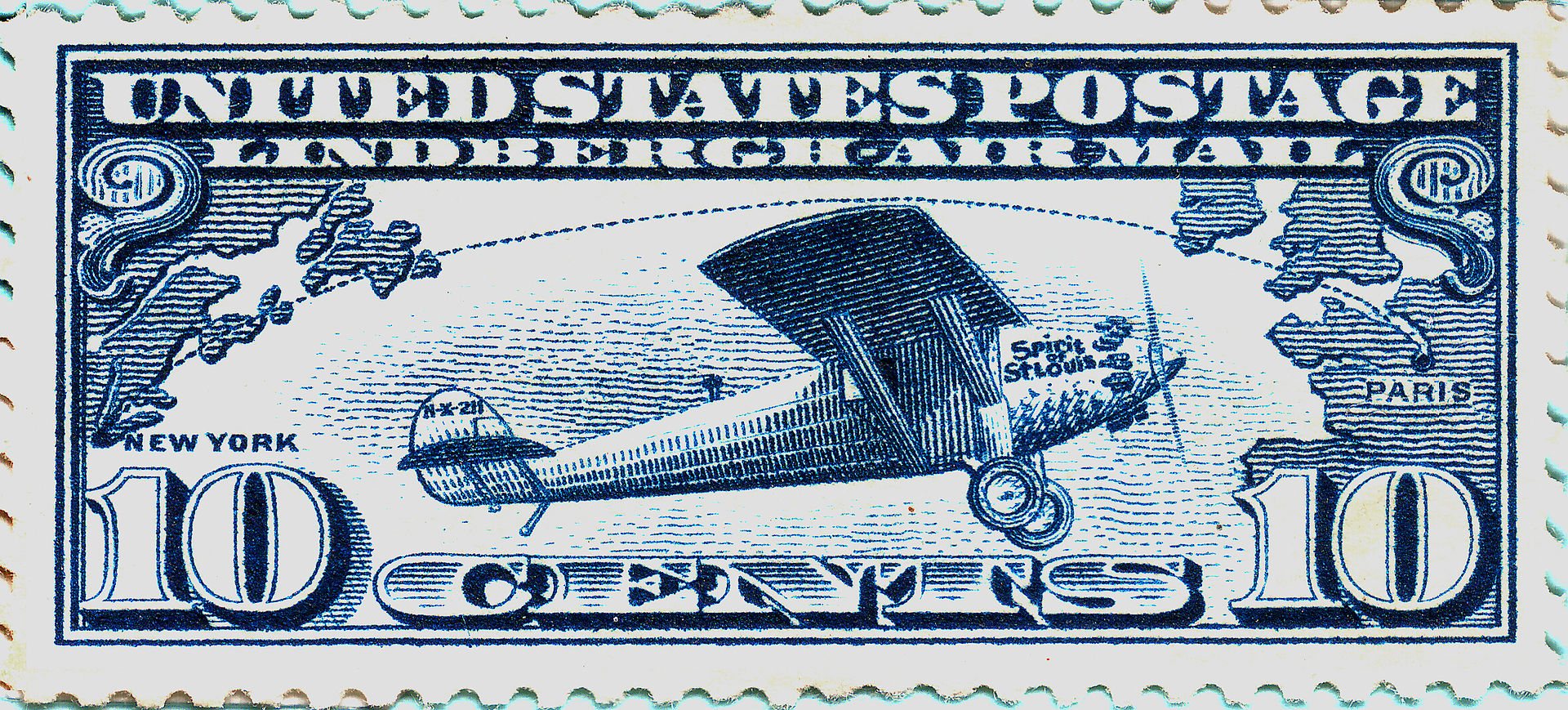
 Charles Augustus Lindbergh (February 4, 1902 – August 26, 1974), nicknamed Lucky Lindy, The Lone Eagle, and Slim, was an American aviator, military officer, author, inventor, explorer, and environmental activist. At age 25 in 1927, he went from obscurity as a U.S. Air Mail pilot to instantaneous world fame by winning the Orteig Prize: making a nonstop flight from Roosevelt Field, Long Island, New York, to Paris, France. Lindbergh covered the 33 1⁄2-hour, 3,600 statute miles (5,800 km) alone in a single-engine purpose-built Ryan monoplane, Spirit of St. Louis. This was not the first flight between North America and Europe, but he did achieve the first solo transatlantic flight and the first non-stop flight between North America and the European mainland. Lindbergh was an officer in the U.S. Army Air Corps Reserve, and he received the United States’ highest military decoration, the Medal of Honor, for the feat.