
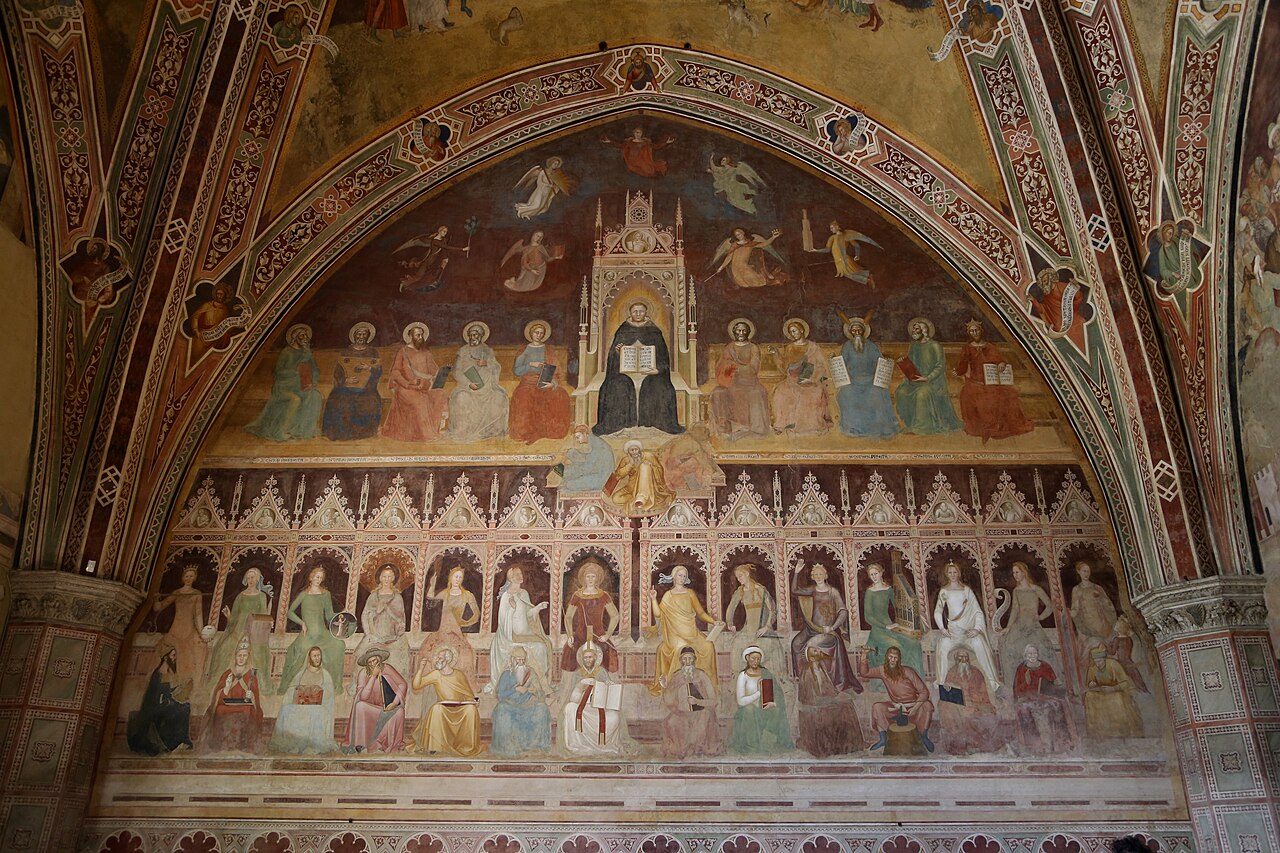
Church history, the Church Fathers, the Schoolmen, and medieval devotion
In the summer of 430 the Vandals had Hippo Regius under siege, and its bishop was dying inside the walls. Augustine was seventy-five. In the third month of the siege he took a fever, and his friend Possidius, a bishop who had fled to Hippo ahead of the same army, tells us how he spent his last days. He had the penitential psalms copied out on sheets and hung on the wall where he could see them from his bed, and he read them and wept. He died on 28 August. He made no will, Possidius says, because as one of God’s poor he had nothing to leave, but he gave orders that the library of the church and all its books be kept carefully for those who came after.
The old man reading the psalms on the wall had spent nearly forty years in public argument. He had written against the Manichees, whose sect he had once belonged to; against the Donatists, who had divided the African church; and against Pelagius and his followers, who taught that a man could keep the law of God by his own strength. Possidius drew up a list of everything he wrote, and the list runs long. The city did not survive the Vandals. The books did.
The last shelf described Christendom as a company of peoples under many kings who confessed one faith, and it ended on the argument that faith carried on with itself. This shelf takes up that argument. The master post put the case for it in two sentences: “Christian doctrine was not handed down complete and uncontested. It was fought over, in public, by men of formidable seriousness, and reading them is how you learn the arguments standing behind the things you say you believe.” The creed a Christian says on Sunday is the settled form of fights recorded on this shelf. The creed is the verdict. These books are the trial.
How the Church Told Its Story
Begin with the story, because every argument on this shelf was made by a particular man, in a particular place, answering someone.
2,000 Years of Christ’s Power, Nick Needham
If a reader buys one book, it should be this one. Needham, a Scottish Reformed Baptist minister, has written a history of the Church in five volumes. The first runs from the apostles to the Third Council of Constantinople in 681, and the second covers the Middle Ages; those two are this shelf’s ground, and the set goes on through the Reformation to the eighteenth century. He writes for the reader in the pew rather than the seminar, and he lets the Fathers speak in their own words.
History of the Christian Church, Philip Schaff
Schaff, born at Chur in Switzerland and later a professor in New York, wrote the great English church history of the nineteenth century, completed after his death by his son David: eight volumes from the apostles to the Swiss Reformation, with maps, notes, and bibliographies in each. Six of the eight cover the ground of this shelf, and the last two belong to the next one, which will point back here. The scholarship has dated in places. Keep it beside Needham, and go to it when Needham is not enough.
The History of the Church, Eusebius
Eusebius, bishop of Caesarea in Palestine, wrote the first history of the Church, in ten books, from the apostles to the victory of Constantine. Much of what is known of the second- and third-century Church survives only because he quoted it. He wrote as Constantine’s admirer, and his last books read like it: read him for what he preserved, and for how the Church first understood its own deliverance.
What the Fathers Answered
Before the Church argued with itself, it argued with the world. These two books answer outsiders: the pagan who thought the Incarnation absurd, and the pagan who blamed the Christians for the fall of Rome.
On the Incarnation, Athanasius
Athanasius, bishop of Alexandria, was driven into exile five times for holding to the faith of Nicaea, and the Church remembers him as Athanasius contra mundum, Athanasius against the world. On the Incarnation is the short early book in which he explains why the Word became flesh: to restore in man the image of God, and to defeat death by dying. It answers pagan and Jewish objections rather than Arius, and it is still the best place to learn what the fight over Arius was about. Get Sister Penelope Lawson’s translation, which carries C. S. Lewis’s introduction, itself the best short argument in English for reading old books.

The City of God, Augustine
Alaric’s Goths sacked Rome in 410, and the pagans said the city had fallen because it had abandoned its gods. Augustine spent thirteen years answering them, and the answer outgrew the occasion: twenty-two books on the two cities, which, he wrote, “two loves have made.” It is the book in which the West learned to read history as having a meaning, and to see that no earthly city, Rome included, is the City of God. Read it beside the shelf on the fall of Rome, where the event it answers is told.
What Grace Does
The hardest fight was inside the Church, and it was over whether a man needs the grace of God to be good. The two books below tell it as one story: a prayer, and the quarrel over it.

Confessions, Augustine
The Confessions is a prayer the length of a book, addressed to God and overheard by the reader: Augustine’s life from infancy to his conversion in a garden at Milan in 386, followed by books on memory, time, and creation. In the tenth book he prays, “Give what you command, and command what you will.” When a bishop quoted that line to Pelagius at Rome, Pelagius could not bear it, and Augustine later recorded as much himself. Read the Confessions first for its own sake, and then for the quarrel it began.
Anti-Pelagian Writings, Augustine
Pelagius, a British monk teaching at Rome, held that a man could keep God’s law by his own will, and denied that the race was ruined in Adam or that grace was necessary. Augustine answered him for nearly twenty years, and the African bishops condemned his teaching at Carthage in 418. This volume of the Nicene and Post-Nicene Fathers gathers nearly all the treatises, with an introduction by B. B. Warfield of Princeton. Begin with On the Spirit and the Letter, written in 412, the book in which Luther, eleven centuries later, found that Augustine had read the righteousness of God as he did.
How Faith Sought Understanding
The Schoolmen took the faith the Fathers had defended and asked how far reason could follow it. Their method was argument in the open: the objection stated at full strength, then answered.
Proslogion and Cur Deus Homo, Anselm of Canterbury
Anselm, born at Aosta in the Alps and later Archbishop of Canterbury, first titled the Proslogion “Faith Seeking Understanding,” and the phrase names the whole medieval enterprise. Its argument for the existence of God was answered at once by a monk named Gaunilo, and Anselm had the objection and his reply copied with the book, which is the scholastic habit in miniature. Cur Deus Homo, “Why God Became Man,” explains the cross as the satisfaction of a debt of honor that man owed God and could not pay. The Reformers inherited his question and sharpened his answer. Most editions print the two works together.
Summa Theologiae, Thomas Aquinas
Thomas Aquinas, an Italian Dominican, wrote the Summa for beginners and died in 1274 with it unfinished. Every article has the same form: the objections, a voice from Scripture or the Fathers on the other side, Thomas’s answer, and a reply to each objection in turn. Nobody reads it straight through. Own the whole of it, in the English Dominican translation, and begin with the existence of God (First Part, Question 2), the treatise on law (First Part of the Second Part, Questions 90 to 97), and the treatise on grace (Questions 109 to 114). Dante set him among the wise in the heaven of the Sun, and that poem stands on the last shelf.
What the Cloister Taught the Heart
The argument was never the whole of it. The men who fought hardest over doctrine prayed hardest too, and the shelf ends where they did.
On Loving God, Bernard of Clairvaux
Bernard was abbot of Clairvaux, the Cistercian house he founded in 1115, and the Cistercians were a reform of the Benedictine life whose Rule stands on the last shelf. He preached the Second Crusade and brought Abelard to account, but On Loving God is the book he is remembered by: a short treatise on why God is to be loved and how, rising through four degrees to the point where a man loves even himself only for God’s sake. Calvin quoted him often.
The Imitation of Christ, Thomas à Kempis
The Imitation came out of the Low Countries in the early fifteenth century, from the movement called the Modern Devotion, and is generally given to Thomas à Kempis, a canon of Mount Saint Agnes near Zwolle. It is four short books of counsel for the inner life, plain enough for anyone and searching enough for anyone. It is often called the most widely read Christian book after the Bible. It closes the shelf on the eve of the Reformation.
The Inheritance
What the Fathers and the Schoolmen handed on is most of what a Christian says when he says what he believes. The Nicene Creed, recited in churches on every continent, is the verdict of the fight Athanasius spent his life in. The confession that a man is saved by grace and not by his own strength is Augustine’s, won against Pelagius. The habit of stating the other side at its strongest before answering it belongs to the Schoolmen, and the universities of Europe were built around it. And the conviction that doctrine and devotion are one life and not two belongs to Bernard and à Kempis. A man who has read these books knows why the words of his creed were chosen, and what it cost to choose them.
The argument did not end with à Kempis. About a century after the Imitation, an Augustinian friar in Wittenberg read On the Spirit and the Letter and found there, he said, what he had not dared to hope for. The next shelf turns to the Reformation, and to the men who read the Fathers again.
Leave a Reply