The Iceland Viking Chant

The visual, literary and performing arts, with some architecture thrown in.
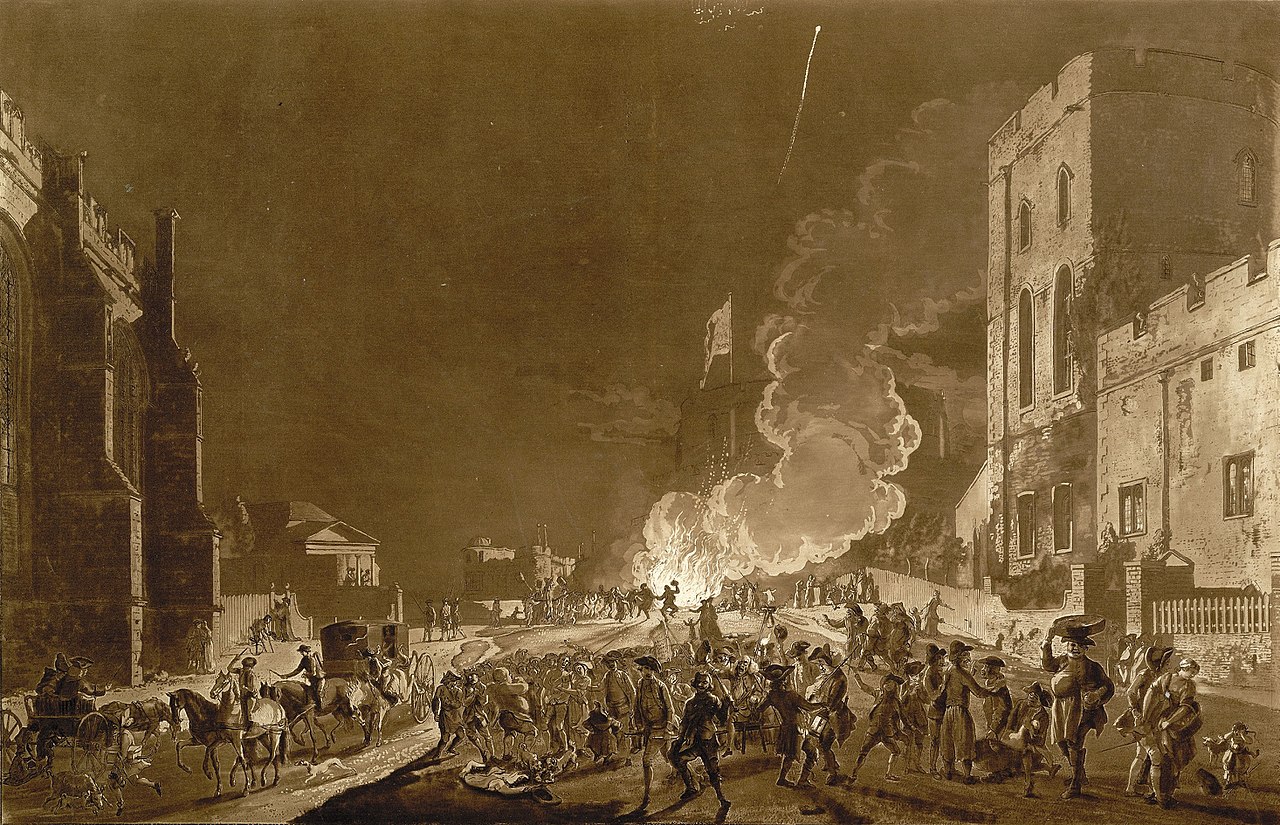
Happy Bonfire Night.
Remember, remember, the Fifth of November
Gunpowder treason and plot
I see no reason why gunpowder treason
Should ever be forgot
Guy Fawkes, Guy Fawkes, ’twas his intent
To blow up the King and the Parliament
Three score barrels of powder below
Poor old England to overthrow
By God’s providence he was catch’d
With a dark lantern and burning match
Holler boys, holler boys, let the bells ring
Holler boys, holler boys, God save the King!
Guy Fawkes Night, also known as Guy Fawkes Day, Bonfire Night and Firework Night, is an annual commemoration observed on 5 November, primarily in the United Kingdom. Its history begins with the events of 5 November 1605, when Guy Fawkes, a member of the Gunpowder Plot, was arrested while guarding explosives the plotters had placed beneath the House of Lords. Celebrating the fact that King James I had survived the attempt on his life, people lit bonfires around London; and months later, the introduction of the Observance of 5th November Act enforced an annual public day of thanksgiving for the plot’s failure. (Via Wikipedia)
An Old Norse expert discusses the relationship between the gods and the “giants” (jǫtnar) in Norse myth.

Was he Aesir or Vanir? Whitest of the Aesir, like the Vanir knows the future. Son of nine giantess mothers. Able to hear so well he can hear grass grow and sight so fine he can watch a wool of a sheep grow.
And hast thou slain the Jabberwock?
Come to my arms, my beamish boy!
O frabjous day! Callooh! Callay!”
He chortled in his joy.
Charles Lutwidge Dodgson 27 January 1832 – 14 January 1898, better known by his pen name Lewis Carroll, was an English writer of world-famous children’s fiction, notably Alice’s Adventures in Wonderland and its sequel Through the Looking-Glass. He was noted for his facility at word play, logic and fantasy.
Guido Reni; 4 November 1575 – 18 August 1642 was an Italian painter of the Baroque period and style, although his works showed a classical manner, similar to Simon Vouet, Nicholas Poussin and Philippe de Champaigne. He painted primarily religious works, but also mythological and allegorical subjects. Active in Rome, Naples, and his native Bologna, he became the dominant figure in the Bolognese School that emerged under the influence of the Carracci. Via Wikipedia.

Jeanne d’Arc is a gilded bronze equestrian sculpture of Joan of Arc by Emmanuel Frémiet inaugurated in 1874.
The original statue was commissioned by the French government after the defeat of the country in the 1870 Franco-Prussian War. It is the only public commission of the state from 1870 to 1914, called the Golden Age of statuary in Paris, the other statues were funded by private subscriptions.
The sculptor took as his model Aimée Girod (1856–1937), a young woman from Domrémy, Joan of Arc’s village in Lorraine.
The statue was inaugurated in 1874. The pedestal was designed by the architect Paul Abadie.
The artist, who made another version of the monument for the city of Nancy in 1889, replaced the horse of the Parisian monument 10 years later by a copy of the smaller Nancy one, which earned him criticism.
The monument was classified as a historic monument on March 31, 1992.
via Wikipedia

This royal throne of kings, this scepter’d isle,
This earth of majesty, this seat of Mars,
This other Eden, demi-paradise,
This fortress built by Nature for herself
Against infection and the hand of war,
This happy breed of men, this little world,
This precious stone set in the silver sea,
Which serves it in the office of a wall,
Or as a moat defensive to a house,
Against the envy of less happier lands,
This blessed plot, this earth, this realm, this England,
This nurse, this teeming womb of royal kings,
Fear’d by their breed and famous by their birth,
Renowned for their deeds as far from home,
For Christian service and true chivalry,
As is the sepulchre in stubborn Jewry,
Of the world’s ransom, blessed Mary’s Son,
This land of such dear souls, this dear dear land,
Dear for her reputation through the world,
Is now leased out, I die pronouncing it,
Like to a tenement or pelting farm:
England, bound in with the triumphant sea
Whose rocky shore beats back the envious siege
Of watery Neptune, is now bound in with shame,
With inky blots and rotten parchment bonds:
That England, that was wont to conquer others,
Hath made a shameful conquest of itself.
Ah, would the scandal vanish with my life,
How happy then were my ensuing death!
Richard II 2.1.45

Phoebus Apollo by Briton Riviere (14 August 1840 in London – 20 April 1920 in London) was a British artist of Huguenot descent. He exhibited a variety of paintings at the Royal Academy, but devoted much of his life to animal paintings.
