I. The meadow
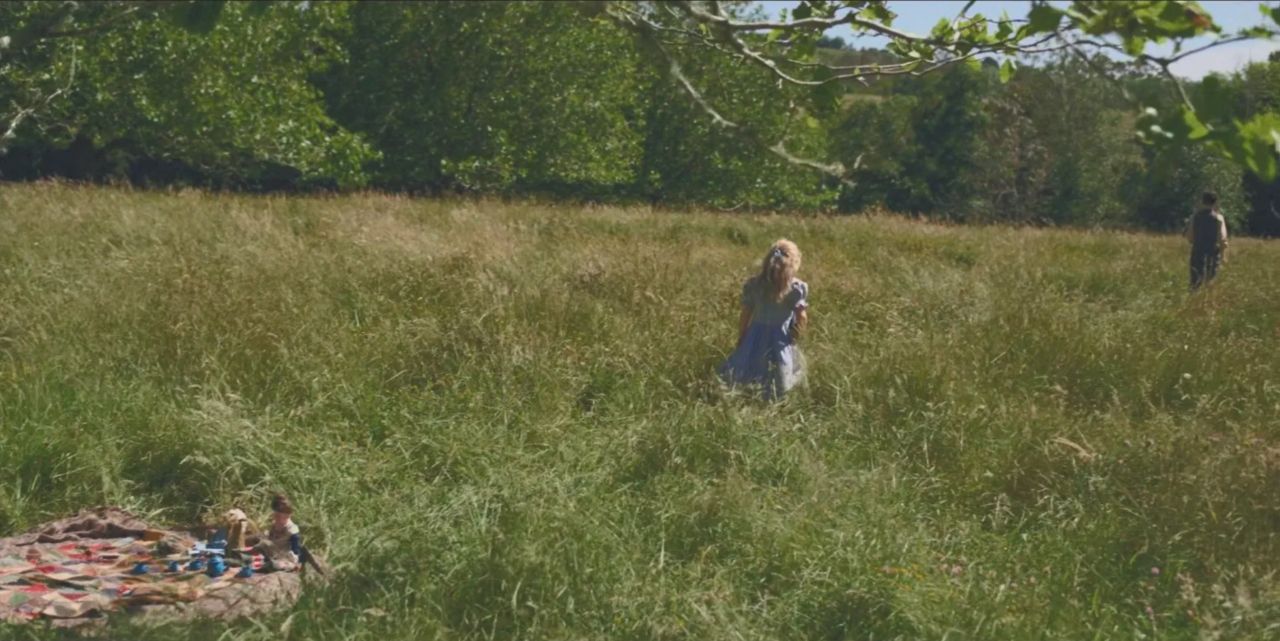
A meadow in high summer. A little girl in a blue dress, hair tied up in a bow, leaves her dolls at a toy tea party. At the tree line an older boy waits with a handful of wrapped sweets. She follows him across the grass toward a hole in the ground, while a grown woman’s voice recites Alice in Wonderland: “I almost think I can remember feeling a little different.” The camera stops at the mouth of the hole and cuts away. It doesn’t have to show us what happens next. The people who made it have told us.
This is the second episode of Netflix’s East of Eden, written by Zoe Kazan, whose grandfather Elia filmed the novel with James Dean in 1955. Elia Kazan’s granddaughter inherited the family property, and treated it like hers. The little girl is Cathy Ames, and the voice is Cathy grown up, telling us this is where she was changed.
That scene is not in the book. Worse, it stands exactly where Steinbeck put a scene that says the opposite.
What Netflix has done to Cathy Ames is not interpretation. It is cultural vandalism: tearing out the moral architecture of an American classic, putting up something else in its place, and letting an audience that will never open the novel believe the new building is Steinbeck’s.

II. What Steinbeck actually wrote
Chapter 8 opens with one of the most famous sentences in American fiction: “I believe there are monsters born in the world to human parents.” As a child may be born without an arm, Steinbeck writes, so one may be born “without kindness or the potential of conscience.” Cathy was not like other people, and never was, from birth.
Before he shows us a single thing she does, he tells us how she works. She learned young that sex was the most disturbing force in human life, “a weapon and a threat.” At ten she “began coldly to experiment with it.” She “planned everything coldly, foreseeing difficulties and preparing for them.”
Then the scene. Her mother hears a giggle from the carriage house, throws open the doors, and finds Cathy on the floor with her skirts up, two boys of about fourteen kneeling beside her, and her wrists tied with a rope. The doctor finds no sign she has been harmed. Cathy refuses to say a word. The boys swear she started it, that they each paid her five cents, and that she had been playing with the rope. Nobody believes them. Their fathers whip them to raw cuts, and they are shipped off to a house of correction. Her father sits through the whole meeting holding the rope, puzzled, and keeps his mouth shut.
Steinbeck doesn’t need to take us inside her head. He told us her method one page earlier, and the rope and the coins finish the sentence. Two boys were whipped bloody for something a ten-year-old girl arranged, and she let them take it.
That is the point of Cathy. Steinbeck gives us no trauma, no cruel father, no origin story. He makes us sit with the harder question: what if evil sometimes just is?
III. The “doorway”
Kazan doesn’t hide what she did. “I cannot help but read it a little differently than Steinbeck’s intention,” she told W magazine. She insists she wanted “textual support” for everything, and that wherever she went beyond the page she needed a “doorway” true to the book.
Fine. Hold her to it.
In the same interview she summarizes the carriage house this way: Cathy wouldn’t speak afterward, and when she did, no one believed her, and she was angry not to be believed. That is flatly wrong. Cathy never tells her story, and the whole town believes it. Her silence is what convicts the boys. The only people in Chapter 8 who are not believed are the two boys telling the truth. The woman who says she needed textual support for everything cannot accurately describe the scene she cut.
Her real doorway is Alice in Wonderland. Near the end of the novel, hours before her suicide, Cathy remembers being a very small girl who sometimes felt surrounded by a forest of enemies, and who wrote “Drink me” on a bottle of sugar water so she could shrink and hide. Kazan, reading it as an adult “having been through lots of therapy,” calls it “a portrait of dissociation.”
Read the passage. The fear comes “now and then.” It comes in early childhood, years before the carriage house. Nothing in it points to any person or any event. Steinbeck gives us a frightened child and pointedly refuses to tell us why she was afraid. Kazan took his silence as an invitation and wrote in the answer from her own vocabulary.
IV. What Netflix built
So here is what now stands where the carriage house used to be.
The two boys are gone. They never appear. Steinbeck’s scene has not been reinterpreted. It has been deleted and replaced with its opposite.
One older boy now leads one small girl away. Two boys and a girl who ties her own wrists is a story that demands thought. A boy luring a little girl with candy demands none. It convicts on sight.
Look at the sweets. In the book the boys pay Cathy five cents apiece. In the series the boy holds out candy to her. The money Cathy took from them has become the bait used on her.
And Alice, the fear Steinbeck left without a cause, has been dragged out of its chapter and planted in the meadow: the blue dress, the abandoned tea party, the rabbit hole, Carroll’s own words about being changed in the night. The passage Kazan offered as her textual warrant has become the set dressing for the scene that needed one.

Steinbeck stages his scene in broad daylight, doors thrown open, the evidence lying on the floor. Netflix shows the approach and lets the dark do the rest. One is evidence. The other is a smear.
In Steinbeck, Cathy uses the appearance of victimhood as a weapon. Netflix turns the appearance into the reality. Apparently Cathy needed a comic-book origin story, a vat of chemicals she got shoved into, some neat little wound we can point at and feel enlightened about. Steinbeck refused to give her one. Netflix gave her one anyway.
V. Grew, the whipping, and “my property”
Netflix does keep Cathy a manipulator with James Grew, the young Latin teacher who kills himself, and it keeps a good deal of Steinbeck: the midnight knock, the shotgun propped on the prayer books, the rumor of “trouble in Boston” that Cathy plants at dinner. But Steinbeck says only that Grew “was never seen with Cathy and no relationship was even suspected.” Netflix fills the blank with a teacher who walks her home, writes her love letters, and talks about the day she will no longer be his pupil. Now the story starts with a grown man pursuing a schoolgirl. Over it, the grown Cathy explains in voiceover how a girl learns to turn men’s attention to her own purposes. Coming minutes after the hole in the meadow, it plays as a lesson she was taught. In Steinbeck it was something she knew from the start.
Then the whipping, where the trick is easiest to catch, because Netflix steals Steinbeck’s own words to cover it.
In the novel the whipping has nothing to do with Grew. At sixteen Cathy refuses to go back to school, runs off to Boston, and is dragged home. Her father, who has never whipped anyone, does it badly, and only because his wife insisted. Cathy “found him out”: she screams and begs, feels the blows go lighter, and turns her face away so he can’t see there are no tears. “See you remember who you are. And don’t forget what I am.” “I won’t forget.”
Netflix keeps those lines word for word. It even keeps the act: she stops crying the moment he leaves the room. Then it throws out the reason for the beating and writes its own. The whipping now follows Grew’s death, the father demands to know what happened between them, and out come the lines Steinbeck never wrote: “You’re my property.” “If you’ve defiled yourself, you’ve defiled my property.”
That is not in Steinbeck either. His Mr. Ames is “a covered man” who suspects his daughter of everything and says nothing, because it is safer not to know. The mother who demanded the whipping has been written out, and so has the disobedience it punished. What’s left is a patriarch beating his daughter over her body and his ownership of it: a gender-studies sermon dropped into the middle of a scene Steinbeck wrote about a calculating girl.
And here is the rotten joke. The father is right. “I know you did something to that young man,” he says, and she did. Netflix takes the novel’s own verdict on Cathy, puts it in the mouth of the one man it has made contemptible, and drowns it in ownership talk so the audience throws out the truth along with him.
Notice what they made of his religion, too. Steinbeck’s Mr. Ames speaks of the authority God gave him. Netflix’s Mr. Ames goes straight from God to “You’re my property.” Scripture says the opposite. Children are “an heritage of the LORD” (Psalm 127:3). They belong to God, and a father holds authority over them as a steward who will answer for it. A Christian father who calls his daughter property has not stated his faith. He has denied it. Netflix needed him to deny it, so it wrote the denial for him.
VI. The fire, and the missing half of a verse
The fire mostly follows the book, and it is the most honest stretch of the episode. Cathy plans her parents’ deaths and her own staged murder with real coldness. But Netflix crushes Steinbeck’s weeks of false sweetness into one evening, and it takes the father’s line “it just needs a little authority,” which in the novel he says the night before she runs to Boston, and drops it on the night of the fire. He says it, she goes up to bed, and the windows explode. In the book the line is irony at a fool’s expense. In the series the cut makes it the fuse.
Before he says it, though, the father reads Genesis at the table. Cain’s offering is refused, and God asks him why he is angry: “If thou doest well, shalt thou not be accepted? and if thou doest not well, sin lieth at the door.”
And there the reading stops.
The verse goes on: “And unto thee shall be his desire, and thou shalt rule over him.” The novel is built on those words. In Chapter 24, Lee and the old men of his family spend years learning Hebrew to settle that one clause, and find timshel: “thou mayest.” Thou mayest rule over sin. “That throws it right back on a man,” Lee says. Even in “his murder of his brother he has still the great choice.”
Netflix quotes the novel’s central verse over a girl about to burn her parents alive, and stops one clause short of the words that say she could choose otherwise. Sin is at the door. The part about mastering it is gone. Whether anyone in the editing room meant it hardly matters. It is the whole adaptation in a single cut.
VII. They told us
Nobody has to guess at the motive. The makers have said it out loud. Co-showrunner Jeb Stuart told TV Insider that Cathy is “not just a bad seed” but “a product of what’s happened to her,” and that her story begins with an event in her childhood. Florence Pugh told TV Week that Kazan’s scripts let her “fill in gaps” Steinbeck left and “give Cathy context and give her motive.”
Context and motive. Steinbeck withheld both on purpose, and they decided he had forgotten.
Kazan’s best defense is Chapter 17, where the narrator wonders whether he was wrong to call Cathy a monster and writes that “it is easy to say she was bad, but there is little meaning unless we know why.” She quotes it accurately. She just stops reading too soon. The same paragraph says that “we cannot know what she wanted,” and that “we will never know.” Steinbeck asks the question and refuses to answer it. Kazan answered it for him and signed his name.
VIII. Thou mayest
Kazan says the book is about change, about not nailing people down forever as only what they are. She is right that it is about choice. That is timshel. But timshel cuts straight through her Cathy. A Cathy made by what was done to her in a hole in a meadow did not fully choose. A Cathy who chose is guilty. Kazan hands moral freedom to every character in the story except the one she rewrote.
We do this outside of fiction too. When evil turns up without a visible cause, we panic and invent one, because a backstory lets us feel wise instead of afraid. Trauma is real, and it shapes people. But inventing it where the evidence says otherwise doesn’t make us more humane. It makes us liars, and it takes away the one thing that makes a human being worth judging at all: that he could have done otherwise.
Steinbeck understood that. He gave us a woman who chose, again and again, and he let her be terrifying. Netflix gave us a victim with a body count and put Steinbeck’s name on it.
Millions of people will watch this and believe Steinbeck wrote it. He didn’t. Read the book.