Greek epic, tragedy, history, and philosophy
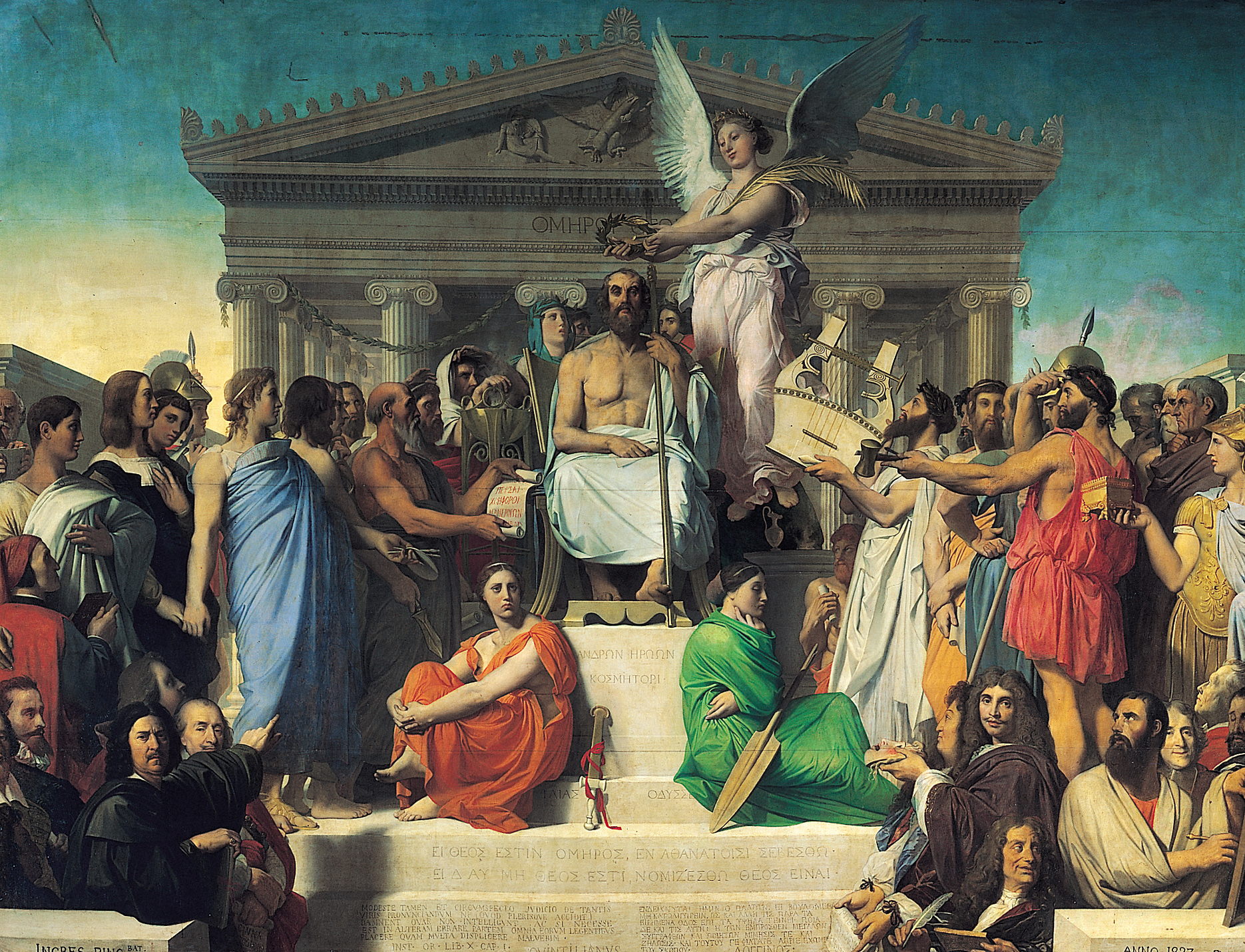
Plutarch tells us that Alexander carried a copy of the Iliad on campaign, a text his tutor Aristotle had corrected, and that he kept it under his pillow beside his dagger. He called it provision for the art of war. The king who took Greek arms to the Indus took Homer with him.
The last shelf of this library held no primary sources at all. Its subject was a people who left no writing, and everything known of them had to be recovered from word roots, pottery, and bone. This shelf begins where the writing does. When Achilles weighs a long life against a short one, he names the glory that awaits him if he dies at Troy kleos aphthiton, unwithering fame, and the same phrase stands in the Vedic hymns of India. It was old before Homer sang it. In Greece the inheritance traced on the previous shelf was written down, then staged, argued over, and turned into history and philosophy, and Europe has been reading it ever since.
This is the second shelf of the library described in Why Build a Library. Nearly every book on it was written by the Greeks themselves. The groups follow the order in which the Greeks came to write: the poets first, then the stage, the historians, and the philosophers, with a single modern guide to open the way.
Who the Greeks Were
The Greeks, H. D. F. Kitto
Kitto wrote this short book in 1951 for readers with no Greek, and it has not been bettered for that purpose. He explains the land and the sea that shaped the Greeks, the polis as a community rather than a state, and the passage from the Homeric age to the classical, and he writes with an affection for his subject that makes the rest of this shelf easier to enter. If a reader buys one book about the Greeks before reading the Greeks themselves, it should be this one.
What the Poets Remembered

The Iliad, Homer
A few weeks in the tenth year of the siege of Troy, from the quarrel between Achilles and Agamemnon to the ransoming of Hector’s body. It stands with the Odyssey at the head of European literature, a poem about honor, wrath, and the cost of both, in which the Trojans are given as much dignity as the Greeks. Every later account of the warrior in this library measures itself against it, knowingly or not.
The Odyssey, Homer
The long homecoming of Odysseus, and the patience of the household that waited for him. Where the Iliad is about the man who would rather die gloriously than live long, the Odyssey is about the man who wants above all to get home, and it sets hearth, marriage, and the obligations of host and guest at the center of the Greek world. Read together, the two poems give nearly the whole range of the Greek idea of a good man.
Theogony and Works and Days, Hesiod
Two short poems from about 700 BC, by the first Greek poet to speak in his own name. The Theogony tells how the gods came to be and how Zeus came to rule them; Works and Days is a farmer’s counsel to his idle brother on labor, justice, and the turning of the seasons. Hesiod gives the order of the gods that the tragedians and philosophers inherited, and a sober picture of the ordinary life that Homer’s heroes stood above.
What the Stage Asked
The Oresteia, Aeschylus
The only trilogy of Greek tragedy to survive whole. Agamemnon comes home from Troy and is murdered by his wife, his son Orestes kills her in turn, and the Furies pursue him until Athena sets up a court at Athens to judge the case. Aeschylus stages the passage from blood vengeance to law, and makes it the founding act of a city.
The Theban Plays, Sophocles
Oedipus the King, Oedipus at Colonus, and Antigone: not a trilogy, but three plays written over more than three decades about one cursed house. Oedipus, who solves every riddle but his own, and Antigone, who buries her brother against the king’s decree, have given Europe two of its permanent questions: whether a man can know himself, and what is owed when the law of the city and the law of the gods divide.
The Bacchae, Euripides
One of Euripides’ last plays, first staged after his death. Dionysus comes to Thebes in disguise, and the king who refuses to honor him is torn apart by the women of the city, his own mother among them. It is the most unsettling play the Greeks left, a study of what befalls a city whose rulers deny the divine, and of what the divine does when it is loosed without measure.
What the Historians Saw
The Landmark Herodotus, Robert B. Strassler, ed.
The first history in the Western tradition; our word history comes from the word Herodotus used for his work, historiē, inquiry. His subject is the war between the Greeks and the Persian Empire, but to explain how it came about he ranges over Egypt, Scythia, and the whole known world, and he preserves customs and stories found nowhere else. The Landmark edition, like the three that follow, sets maps beside nearly every page and adds essays by specialists, and for a reader coming to the ancient historians for the first time that apparatus makes the difference.
The Landmark Thucydides, Robert B. Strassler, ed.
The war between Athens and Sparta, written by an Athenian general who fought in it and was exiled for failing at it. Thucydides meant his book to be a possession for all time, and it is: his accounts of the plague at Athens, the Melian Dialogue, and the disaster in Sicily remain among the most clear-eyed writing on power, fear, and the breakdown of a political community in any language. The Landmark uses Richard Crawley’s Victorian translation, revised, which is heavier going than modern versions and worth the effort.
The Landmark Xenophon’s Hellenika, Robert B. Strassler, ed.
Xenophon takes up the story where Thucydides breaks off, in 411 BC, and carries it through the fall of Athens, the brief supremacy of Sparta, and the rise of Thebes, to the battle of Mantinea in 362. He was an Athenian who admired Sparta and served beside its king, and his history shows it. Where Thucydides analyzes, Xenophon tells, and his is the only full account of these years by a man who lived through them.

The Landmark Arrian, James Romm, ed.
The fullest surviving account of Alexander’s campaigns, written in the second century AD by a Greek who had governed a Roman province and commanded Roman troops. Arrian built it chiefly on the lost memoirs of Ptolemy and Aristobulus, two men who marched with Alexander, and he writes as a soldier about a soldier: clear on tactics, generous to his subject, sparing with gossip. The Landmark’s maps make the march from Macedonia to the Indus possible to follow.
The History of Alexander, Quintus Curtius Rufus
The other full-length ancient narrative of Alexander, written in Latin, probably in the first century AD. Curtius drew on a tradition far less friendly to the king than Arrian’s, and his Alexander is a brilliant commander undone by success, sliding toward Persian luxury, suspicion, and cruelty. Read beside Arrian, he teaches the first lesson of ancient history: the sources are themselves an argument.
How a City Should Be Ordered

Lives, Plutarch
Paired biographies of Greek and Roman statesmen, written by a Greek priest of Delphi under the Roman peace. Plutarch was a moralist more than a historian, concerned with character rather than chronology, and that is his use: his lives of Lycurgus and Solon are the principal accounts of how Sparta and Athens were given their laws, and his Pericles, Alexander, and the rest show what the Greeks believed a great man ought to be.
The Republic, Plato
Plato’s great dialogue on justice, which answers its question by building a city in speech, ruled by philosophers and guarded by a class trained from childhood to serve it. It holds the allegory of the cave, the myth of the metals, and the argument that soul and city are ordered alike, so that a disordered soul makes a tyrant. Few books have been argued with so continuously for so long, and none of the arguments makes sense without it.
The Laws, Plato
Plato’s last and longest work, in which an old Athenian, a Cretan, and a Spartan walk to a shrine of Zeus and design the laws of a new colony. Where the Republic imagines rule by the wise, the Laws settles for rule by law, and it gives close attention to religion, education, marriage, and the household as the things a lawgiver must get right. It is less read than the Republic, and in some ways the more practical book.
Nicomachean Ethics, Aristotle
Aristotle’s account of the good life, which he finds in virtue exercised over a whole lifetime: courage, temperance, justice, friendship, and above all practical wisdom, acquired by habit rather than argument. It is the foundation of the tradition of the virtues that Aquinas would carry into Christian thought. Aristotle closes it by turning to the Politics, since virtue is formed by habit and habit by law.
Politics, Aristotle
Aristotle’s study of the city, grounded in the observation that man is by nature a political animal, and that the household and the village come before the polis as its parts. He compares the constitutions of his day, which his school collected by the score, and weighs monarchy, aristocracy, and constitutional government against their corruptions into tyranny, oligarchy, and democracy. It is the most empirical political book the Greeks left, and the source of the vocabulary Europe has used for government ever since.
The Inheritance
What Greece handed on was not a single doctrine but a set of forms: epic and tragedy, history and the dialogue, and the habit of asking what a good man is and what a good city ought to be. The books on this shelf argue with one another as often as they agree, but they fixed the terms, and every later shelf of this library uses them. The New Testament itself was written in their language. The Greeks could not keep what they made: their cities wore one another out in war, Alexander’s heirs divided his conquests, and the inheritance passed into the keeping of a people who had begun as a single city on the Tiber. The next shelf turns to Rome.