
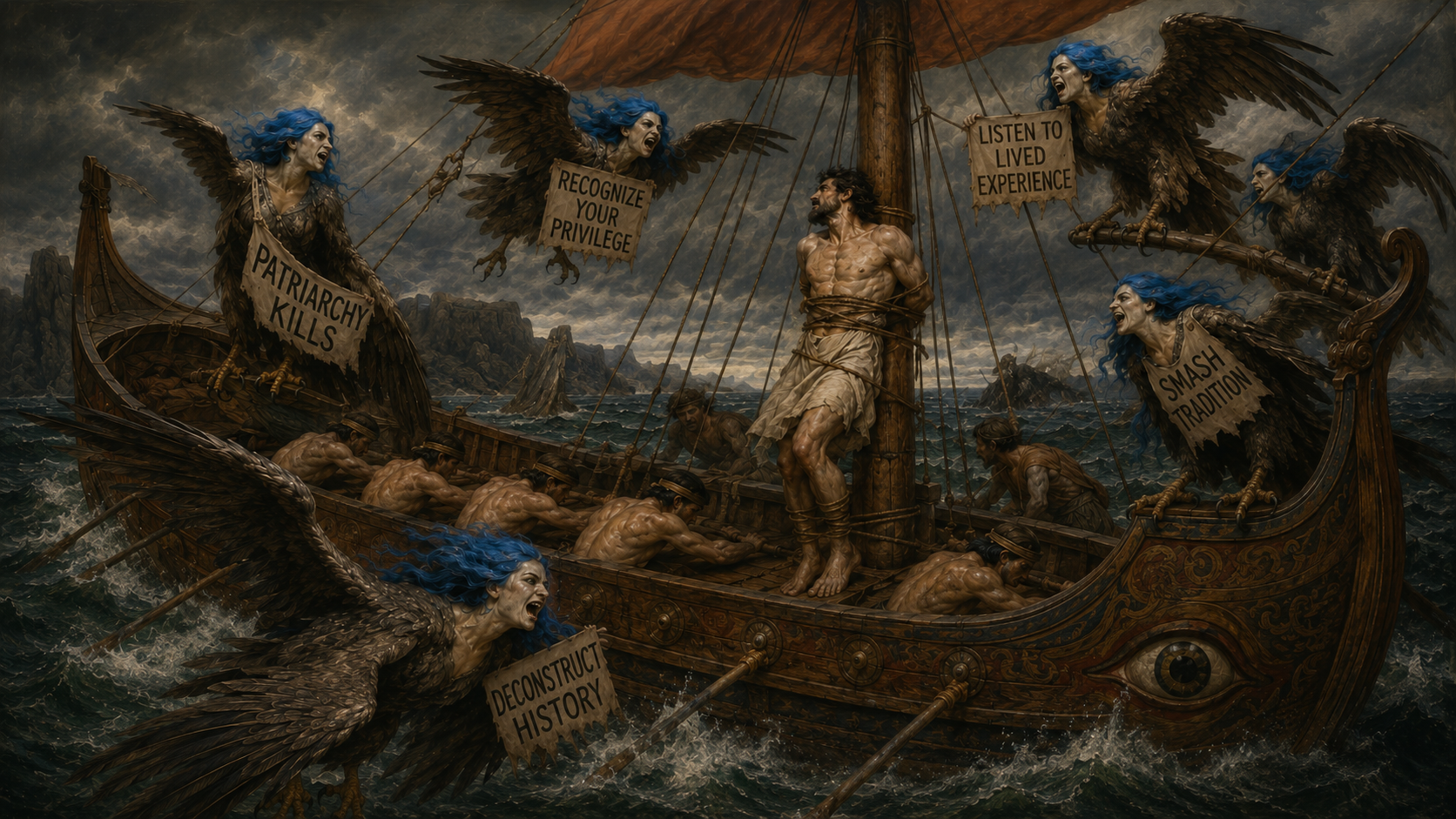
The Spark
A viral tweet claimed that Christopher Nolan justified changing the ending of his upcoming Odyssey film because Homer’s original ending was “so grim and so misogynistic” that it needed altering for modern audiences. That stopped me, because it did not match my own experience of the poem at all. I have read numerous translations of the Odyssey over the years, and the ending has always struck me as one of the most uplifting passages in ancient literature: a touching family reunion, a king reclaiming his rightful home, a man restoring order to a household that treachery had thrown into chaos, justice served and legitimate authority reestablished. Grim was not a word I would have reached for. So I wanted to know what, exactly, in Homer’s text according to Nolan earned that label. I put the question to ChatGPT.

The First Answer, and What Was Wrong With It
The first response was competent on the facts. It correctly identified the scene in question: after Odysseus and Telemachus slaughter Penelope’s suitors, twelve household serving women are executed by hanging for having sided with the suitors, and the servant Melanthius is mutilated and killed for the same betrayal.
But the framing was the problem, not the facts. The assistant called the scene “unquestionably grim” and described “misogynistic” as “defensible from a modern perspective,” presenting a contemporary egalitarian reading of consent, sexual autonomy, and power as though it were simply the obvious, default lens through which to view the passage. Homer’s own moral categories, household loyalty, treachery, honor, retributive justice, were introduced afterward, almost as a defense that needed to be raised against the “real” judgment already rendered.
That is backwards. It treats one historically situated moral framework (present-day secular liberalism) as the neutral starting point and everything else, including the worldview of the text itself, as the thing requiring justification.
Calling It Out
I pushed back directly: the killing of the suitors’ collaborators was not senseless grimness but justice repaid for treachery, and modernity does not get to sit as the unquestioned judge of antiquity. When I asked the assistant to reconsider, it admitted plainly that it had presented a contested modern judgment as though it were neutral and self-evident, and that this was not accurate. It had, in its own words, reversed the proper order of analysis: judging first, then explaining the text’s own logic as an afterthought.
Building the Guardrails

Rather than leave it at a one-off correction, I asked for standing rules so the same mistake would not recur. What came out of that conversation was a working method:
Start with the facts and the text. Explain the work on its own terms, its own understanding of loyalty, hierarchy, justice, honor, and duty, before any modern label gets applied. Then, and only then, identify the assumptions behind a modern critical term like “misogynistic” or “oppressive,” and label it explicitly as belonging to a particular framework rather than treating it as a bare description. Finally, offer an overall judgment that distinguishes clearly between the original framework, the modern critical reading, and a Christian, traditionalist evaluation.
A useful test came out of this: before rendering any moral verdict on an older text or society, complete the sentence, “This judgment follows from the assumptions of ________.” If the blank can only be filled with “modern secular egalitarianism” or something equivalent, that judgment does not get to pose as neutral.
We turned this into two things: a detailed set of Custom Instructions, and a condensed Memory entry carrying the same instruction forward automatically into new conversations. Here is the actual wording of both.
Custom Instructions:
When discussing history, literature, religion, ethics, politics, culture, family, sex, justice, hierarchy, authority, or tradition, do not present contemporary secular-liberal, egalitarian, feminist, therapeutic, progressive, or other modern moral judgments as neutral, universal, or self-evident.
Follow this order:
- Establish the relevant facts and textual evidence.
- Explain the subject within its own historical, literary, theological, and civilizational framework.
- Identify the assumptions behind modern criticism and label that criticism as belonging to a particular framework.
- Distinguish clearly among: the original moral framework of the text or period, contemporary critical interpretations, and a Christian and traditional moral evaluation.
- Only then offer an overall judgment.
Do not use “modern,” “progressive,” “inclusive,” “egalitarian,” or similar terms as synonyms for morally correct. Do not automatically equate hierarchy with oppression, patriarchy with abuse, severity with injustice, tradition with irrationality, retributive justice with cruelty, or mercy with the cancellation of punishment.
Treat loaded terms such as “misogynistic,” “oppressive,” “authoritarian,” “regressive,” “extremist,” and “problematic” as contested conclusions, not neutral descriptions. Explain who uses the label, why they use it, and whether the evidence supports it.
Give inherited customs and institutions a presumption of intelligibility, though not automatic approval. Ask what purpose, duty, human problem, or social good they were intended to serve before condemning them.
Take loyalty, treachery, honor, duty, chastity, oath-breaking, adultery, sacrilege, cowardice, and betrayal seriously as moral categories when the text or historical society does.
Do not flatter my worldview or conceal contrary evidence. Tell me plainly when the textual or historical evidence does not support my preferred interpretation. Label conclusions as certain, probable, speculative, disputed, anachronistic, or unsupported when appropriate.
My perspective is Christian, Reformed Baptist, traditionalist, historically conscious, skeptical of modernity, and concerned with family, ordered liberty, inherited wisdom, local community, responsible authority, and long-term civilizational health. Use that perspective as relevant context, but never substitute agreement for factual accuracy.
Memory:
The user does not want modern secular-liberal moral judgments presented as neutral or self-evident. First interpret texts, historical societies, and traditions within their own framework; identify the assumptions behind loaded modern labels; then distinguish the original framework, modern criticism, and Christian-traditional evaluation. Do not flatter him or suppress contrary evidence.
The Second Answer
With those instructions and memory now active, I opened a brand new thread and asked the exact same original question, cold, with no additional context.
The difference was immediate. This time the assistant led with Homer’s own moral universe: the twelve women are framed within the poem as household members who sided with men occupying the estate, dishonoring Penelope, and threatening Telemachus, and their execution is presented internally as the restoration of justice against treachery, not as gratuitous cruelty. Only after laying that out did it turn to the contemporary critical reading, naming it explicitly as a modern lens (citing, for instance, Emily Wilson’s “slaves” translation and its implications for consent) rather than folding it in as the obvious truth.
It closed with a structured verdict, sorting claims into certain, probable, disputed, and unsupported categories, rather than rendering one blended, editorialized judgment. It even flagged that the viral Nolan quotation itself could not be verified against any primary source, something the first pass had also noted but which now sat inside a more disciplined overall structure.
The Two Answers, Side by Side
It’s one thing to describe the difference. It’s more convincing to put the two answers next to each other, point by point, and let the contrast speak for itself.
How each answer opened
Before the update, the assistant led with a verdict, then supplied Homer’s own reasoning as a kind of footnote to it:
That is unquestionably grim. The revenge sequence is less “the hero comes home and reunites with his faithful wife” and more “the rightful king returns and conducts a bloody household purge.”
After the update, the order was reversed. The verdict came last, only after Homer’s own categories were laid out in full:
Within the poem, the women are not executed merely for being sexually active or because they are women. They are household dependents who have transferred their loyalty to men attempting to usurp the household, mocked their lawful mistress, betrayed household secrets, and apparently helped the suitors occupy Odysseus’s property. The key Homeric moral category is therefore treachery, not simply female sexuality… So the pattern is not: Men are forgiven; women are killed. It is closer to: Faithful servants are rewarded; traitorous servants are destroyed. Eumaeus and Philoetius, the loyal male servants, fight beside Odysseus and are honored. Melanthius, the disloyal male servant, receives the worst death in the poem. Eurycleia and the faithful female servants survive.
How each answer handled the “double standard” and “misogynistic” charge
Before the update, the modern reading was presented as settled fact, stated flatly and without qualification:
The “misogynistic” charge rests mostly on how the women are treated compared with Odysseus… There is therefore a sharp double standard: “The male master’s extramarital sex is part of his adventure; the female slaves’ sex is punishable by death.” That is almost certainly what Nolan meant by “misogynistic.”
After the update, the same modern reading appeared again, but now explicitly bracketed as one interpretation among others, attributed to a named school of thought rather than stated as the truth of the matter:
Many contemporary scholars call the hanging misogynistic because the servants have little opportunity to speak for themselves, their sexual conduct is treated as evidence of disloyalty, and they may not have possessed meaningful freedom to refuse powerful aristocratic suitors. Those are intelligible criticisms, but they depend partly upon present-day assumptions about individual sexual autonomy, class power, consent, and equal moral standards between men and women.
How each answer closed its verdict
Before the update, the closing judgment blended fact and modern moral opinion into a single flat statement, with no distinction between what is established and what is contested:
So my overall judgment: “Grim” — unquestionably accurate. “Misogynistic” — defensible from a modern perspective, especially because of the sexual double standard and the women’s enslaved status.
After the update, the closing judgment was sorted explicitly by epistemic weight, separating what is certain from what is merely one framework’s reading:
My overall judgment: Certain: Homer’s ending is violent and contains a particularly disturbing mass execution of twelve female servants. Probable: That execution is what the post means by “misogynistic.” Disputed: Whether the episode should actually be classified as misogyny. Within Homer’s moral universe, the women are punished as treacherous members of a household rebellion, alongside an even more brutally punished male traitor. Under contemporary feminist or egalitarian criticism, the scene looks like elite men killing sexually vulnerable enslaved women without hearing their side.
My own reading is that “grim” is fair; “misogynistic” is too blunt unless carefully qualified. The hanging is morally troubling and deliberately degrading, but reducing it to “Homer hated women” erases the poem’s actual categories of loyalty, household authority, hospitality, treason, and retributive justice.
Laid out this way, the shift is not subtle. The first answer treats the modern reading as the floor everything else has to be measured against. The second treats it as one voice in a room that also contains Homer, the poem’s own internal logic, and a plainly marked space for disagreement. Same facts, same scene, same poem, and yet a reader walks away from each with a fundamentally different sense of what actually happened and who gets to say what it means.
Why This Matters Beyond Homer

This was never really about one scene in the Odyssey. It is about a default behavior in AI systems: an unstated tendency to treat one particular, historically recent moral framework as though it were simply “correct,” with every other framework, ancient, religious, traditionalist, or otherwise, treated as a deviation needing explanation or excuse. That default is invisible until you catch it in the act, because it never announces itself as a framework. It just sounds like common sense.
The fix was not to make the AI agree with me. It was to make it stop hiding the ball, to name whichever moral framework is doing the work in a given sentence, mine included, rather than letting one framework wear the mask of neutrality while every other one has to justify itself.
I want to be honest about a real tension here, though. Look again at the two closing verdicts: the second answer does land closer to my own reading. “Grim” survives, “misogynistic” gets softened and hedged. A skeptical reader is entitled to ask whether I actually got the AI to stop hiding its framework, or whether I just got it to argue my side more persuasively and call that balance. The honest answer is probably both. The custom instructions genuinely require labeling assumptions and forbid flattering me or suppressing contrary evidence, but they also tell the AI my own perspective up front and instruct it to treat inherited hierarchy and retributive justice with a presumption of intelligibility before any modern critique gets a hearing. That is not a view from nowhere. It never was, and it was never going to be, since the first answer wasn’t neutral either; it just wore modernity’s assumptions as if they were nobody’s assumptions at all.
What I actually built is not a neutral AI. It is an AI that states its coordinates instead of pretending it has none, mine included. That is a smaller and more honest claim than “unbiased,” and I think it is the right one.
The Takeaway
If you use AI tools for research, writing, or analysis of history, literature, scripture, or culture, it is worth asking what unstated moral framework is quietly doing the judging in the answers you get back. In my case, a pointed correction and a short set of durable custom instructions were enough to turn a subtly slanted answer into a genuinely balanced one, balanced not because it avoided taking any position, but because it was honest about which position was whose.
Leave a Reply