Tag: Traditionalism

  • Eighty-Seven Questions

    Eighty-Seven Questions

    I. The Word Stopped Fitting

    For most of my adult life, when someone asked about my politics, I said I was a conservative. It was the shortest true answer available, and for a long time it was close enough.

    It was not always the answer. I started out a Democrat, or thought of myself as one. My first presidential election was 1992, and the candidate I remember liking was Ross Perot, the Texan with the charts who warned that American jobs would go south if NAFTA passed. Nine years later the towers came down, and something in how I thought about my country and its enemies moved and did not move back. In 2004 I voted for George W. Bush. After that the drift ran one direction, and it did not slow down.

    Somewhere along the way the word stopped fitting. It told people I would probably vote Republican, which was true, and nothing about why, which was the part that mattered. It put me alongside men whose foreign wars I thought ruinous, whose deference to corporations I thought had helped hollow out the towns they claimed to speak for, and whose politics was mostly a career. I was hostile to communism and to liberalism alike, but “conservative” could not tell you what I was for, and it had nothing to say about the things I cared about most.

    So I tried something. Not another online quiz, though I will come to those, but an interview: eighty-seven questions, asked one at a time by an AI told to behave less like a test and more like a political philosopher who keeps noticing what your answers imply. What came back was not a score. It was a map, and the map had a center I had never quite put into words.

    II. What the Quizzes Measure

    Most people who have wondered about their own politics have taken one of the online quizzes. The best known is the Political Compass, which plots you on two axes (economic left and right, authoritarian and libertarian) and drops a dot on a square. Others promise to match you with a party or a candidate. I have taken several. They were not useless. They were answering a smaller question than the one I was asking.

    The first problem is that the categories come first. Before you answer anything, the quiz has already decided which distinctions matter, and all it can measure is how far you stand from boxes someone else drew. A man can be culturally traditional, suspicious of free trade, hostile to socialism, attached to private property, doubtful about democracy, opposed to foreign wars, and more wary of large corporations than of his county sheriff. Put him on two axes and every one of those facts is averaged into a single dot, and the dot tells you almost nothing about him.

    A cluttered schoolroom in which a seated schoolmaster strikes the hand of a weeping boy with a wooden paddle while other children watch or ignore them.
    The Village School, about 1670, by the Dutch painter Jan Steen, born in Leiden (National Gallery of Ireland, Dublin). The master already knows the right answer; the only question is whether the boy gave it. Most political quizzes are built on the same plan.

    The second problem is that everyone gets the same questions, which wastes most of them. Once a man has said plainly that unrestrained markets are dangerous, there is no point asking him three more times whether he wants more government or less. The useful question is why he rejects them. The answer might be socialism, or distributism, or tariffs, or old-fashioned anti-monopoly sentiment, and those are very different men. A fixed quiz cannot ask that question, because it does not know it needs to.

    The third problem goes deepest. A quiz records positions, not the principles underneath them. Two people can both favor restricting immigration, one because he wants higher wages and the other because he believes a nation is a historical people and not a stack of paperwork. They check the same box. They do not hold the same politics.

    What comes out the other end is a verdict like “you are 82 percent conservative.” It is precise, and it is empty. It tells you where you stand relative to a word. It does not tell you what you believe.

    III. An Interview, Not a Test

    The alternative was simple to state. Instead of a fixed questionnaire, I asked the AI to conduct an interview: one question at a time, each chosen partly in light of everything I had already said.

    Most questions came with lettered options, but the options were prompts rather than boxes. I could pick one, pick several, reject all of them, qualify an answer, or say something else entirely. “No opinion” was recorded as undecided, not forced into a guess. If I corrected myself later, the correction replaced the earlier answer. After each reply the AI said briefly what the answer seemed to show, noted any tension it created with what I had said before, and then chose the next question.

    There was no quota. The ground was wide: first principles such as authority, liberty, and equality; constitutional structure; nation and citizenship; economics; family; religion and public morality; foreign policy; justice and civil liberties; the institutions and elites that run things. But the order and the depth were set by my answers. A reply that closed a question moved the interview on. A reply that opened one kept it there. The interview was to stop when further questions stopped changing the picture, and for me that took eighty-seven.

    Two instructions mattered most. The AI was not to assign a label at the start, and it was not to collapse the result into left and right, a party, or a number on a compass. It was also not to tell me what I ought to believe. Its job was to be interviewer, classifier, and pattern detector, and to answer one question at the end: given everything this man has said, what political philosophy does he actually hold?

    That second instruction was not a formality. I have written before about how readily these systems present one contested moral framework as the neutral starting point and judge everything else against it. An interviewer who has already decided which answers are respectable will steer toward them, however politely. The point of the exercise was to be mapped, not managed.

    IV. Where the Branches Turned

    The method is easiest to see in the moments where one answer changed the direction of the whole interview. Three of them did most of the work. The questions below are as the AI put them. My answers were spoken aloud, and I have tidied them for print without changing what they say.

    Liberty and order

    When liberty and social order collide, which should usually win? Imagine an activity that is peaceful and voluntary, but that you believe is clearly corrosive to family life, public morality, or the long-term health of society.

    A. If it doesn’t violate someone else’s rights, government should leave it alone.
    B. Government may legitimately restrict it if the social harm is serious enough.
    C. It depends heavily on whether the issue should be handled by family, church, local government, state government, or the federal government.
    D. Some combination of B and C.

    My answer:

    A is wrong. Just because something doesn’t violate someone else’s rights doesn’t mean the government should leave it alone. It harms the individual, and who knows what he might have contributed to civilization if he weren’t pursuing something destructive. So yes, government may legitimately restrict it if the harm is serious enough.

    Up to that point I had talked a good deal about rights and limited government, and a fixed quiz would have filed me as a libertarian. The interview noticed instead that I had just rejected the libertarian test of legitimacy: that anything which harms no one else’s rights is beyond the law’s reach. The questions that followed turned to public morality, inherited moral tradition, and who gets to decide what counts as social harm.

    The franchise

    Should every adult citizen have an equal vote?

    A. Yes. Universal adult suffrage is the fairest and most legitimate system.
    B. Generally yes, even though voters vary enormously in judgment and civic virtue.
    C. No. Voting should probably be conditioned on some demonstration of stake, responsibility, competence, citizenship, or civic qualification.
    D. I’m skeptical of mass democracy itself. Political representation should be filtered through institutions, local bodies, property, family, profession, or some other mediating structure rather than simple one-person-one-vote majoritarianism.

    My answer:

    D. I’m very skeptical of mass democracy itself. Universal suffrage is not the fairest or most legitimate system. That people who abuse the system and live off it should have an equal vote with the producers, the net contributors to the society, is outrageous. So, D.

    A conventional survey would have gone on to ask about voter access and turnout. The interview dropped all of that and asked what representation should rest on instead: property or taxation, the household, civic qualification, the local community, or some mixture. I said all of them mattered, and I reached for Heinlein’s Starship Troopers, where the vote belongs to those who have served. That opened a line of questions about national service, political privilege, and the difference between the rights every citizen holds and the authority to govern.

    Markets and the common good

    What do you think about capitalism?

    A. Free markets are generally the best system, and government should interfere as little as possible.
    B. Markets are useful, but they are subordinate to the national interest, family stability, and social order.
    C. Large corporations and finance can become as dangerous as government and should be restrained when they damage communities, workers, or national independence.
    D. Protectionism, tariffs, industrial policy, and limits on offshoring are legitimate if they preserve domestic production and national strength.
    E. Some combination of B, C, and D.

    And underneath it: if a policy makes the country richer overall but destroys local industries, weakens families, and hollows out towns, is it still a good policy?

    My answer:

    No, free markets are not generally the best system. Left unchecked, runaway capitalism can be as destructive to a nation as communism. Markets are useful, but they should be subordinate to the national interest. Large corporations and finance can absolutely become as dangerous as government and should be restrained when they damage communities, workers, and national independence. So B and C, and D as well. If a policy makes the country richer but destroys local industries, weakens families, and hollows out towns, it is a bad policy. Capitalism should exist to let people live a good life. A line on a chart going up forever is not the goal. A people well cared for is.

    That one answer ruled out both laissez-faire and socialism, and the interview stopped asking whether I wanted more government or less. It asked instead about concentrated corporate power, antitrust, foreign ownership, banking and usury, automation, and whether ordinary families ought to own property. What emerged was not “right-wing economics” but something older and less familiar, which the next section describes.

    V. The Map

    After eighty-seven questions, the AI offered a short label: Christian paleonationalist. The longer version ran like this. A Christian traditionalist and paleonationalist: strongly federalist and localist, anti-majoritarian, family-centered, producerist and protectionist in economics, noninterventionist abroad, with Hoppean sympathies toward constitutional monarchy and a restricted franchise.

    That is a mouthful, and the label matters less than what sits under it. When the AI was asked for the one principle that kept recurring beneath the answers, it did not say “right wing.” It said inheritance and stewardship. Each generation receives goods it did not make, among them its faith, its families, its nation, its laws, its land, and its memory, and it is not free to spend them down. Politics exists to secure the common good of a people across generations: to keep a Christian moral order, and to protect the families, property, local communities, and institutions through which that inheritance passes. Nearly every answer I gave turned out to be an application of that.

    Authority. Political authority comes from God. Consent matters, but a majority vote does not make a thing legitimate. Christianity should hold a recognized place in public life and law. Non-Christians are owed civil toleration, and no one can be made a Christian by force, but the law need not pretend every faith is equally authoritative. That includes laws against blasphemy, and restraint of cultural industries that work steadily against the moral order the law exists to keep.

    Representation. Voting is a trust, not a natural right. It should rest on things that give a man a stake in the outcome and the judgment to use it: property, independence, contribution, civic knowledge, service, the care of a household, roots in a place. The household, not the isolated individual, is the natural unit of representation. A citizen permanently dependent on the government has a plain conflict of interest in holding an equal share of power over it. Senators should again be chosen by state legislatures, as they were before 1913, and the House should represent actual communities rather than counted heads.

    A large room of seated delegates in eighteenth-century dress watching five men present a document to a man seated at a desk.
    Declaration of Independence, 1818, by the American painter John Trumbull, born in Lebanon, Connecticut (United States Capitol Rotunda). In 1776 every one of the thirteen colonies tied the vote to property or taxes, and none of the men in this room thought that made them less than free.

    Constitution and crown. The Constitution is sound and badly interpreted. It should be read strictly, with real federalism, a far smaller administrative state, a restrained Supreme Court, and states that keep the right of peaceful separation. I am also open to constitutional monarchy. Hans-Hermann Hoppe’s argument persuades me here: an elected official holds power for a few years and has every incentive to spend the country’s capital while he can, while a hereditary ruler has reason to hand on a realm in better condition than he found it. The king I have in mind is bound by Christian law, the constitution, custom, the courts, and the lesser authorities beneath him. A king who turns tyrant may be resisted and removed.

    Nation. A nation is a historical people, bound by language, religion, custom, memory, ancestry, and inherited institutions. It is not a set of papers. Newcomers can join it, but by real assimilation, not by filing a form. Immigration policy exists to preserve the nation, not to raise GDP. Citizenship should be hard to earn and open to those who become English-speaking Christians, contribute, and commit for the long term. Even then, holding citizenship and holding power over the country are different things, and the second should wait on deeper roots. America itself is less one people than a federation of related regional peoples, Texas, the South, New England, Appalachia, the Midwest, and those differences should be kept rather than ground down.

    Economy. I hold private property and inheritance in high regard. That means low and flat taxes, no property tax, balanced budgets, decentralized banking, and as many families as possible owning something of their own. But the economy exists for the household, not the other way round. That justifies tariffs, domestic industry, antitrust, limits on foreign ownership of farmland and strategic assets, usury laws, and care for the land. Automation is good when it serves the men whose work it changes. Looking back, the candidate I liked in 1992 was the first sign of this.

    Family and morals. The family is the basic unit of society. Marriage is a covenant, not a private contract, and divorce should require cause. Parents hold primary authority over education. I oppose the welfare state and would return charity to families, churches, and local institutions. But I favor policy that makes marriage and children easier to afford, because it builds independence rather than dependence. Pornography, prostitution, hard drugs, and commercialized vice should be prohibited, with the heaviest penalties for those who profit from them. Culture is upstream of politics, and the law has a duty to the moral climate a people lives in.

    The sword. Punishment should aim at deterrence, incapacitation, and restitution, and the death penalty is legitimate for the gravest crimes. Citizens should be able to bear the same kind of small arms a soldier carries, for defense, for the militia, and as a final check on tyranny. Policing belongs to sheriffs and localities. Abroad, the nation should be overwhelmingly strong and slow to act. It should defend its borders and its people, and leave off remaking other countries. The American empire built after 1945 has done real harm at home.

    Beneath all of it is a view of hierarchy. Men are equal before God and before the law, and unequal in almost everything else. A healthy society cultivates a governing class out of family continuity, property, education, service, and Christian character. It also strips standing from members of that class who prove corrupt or incapable, and it holds all of them to the same civil law as everyone else.

    VI. What I Am Not

    The AI was also asked which labels would mislead, and that list turned out to be nearly as useful as the map.

    I am not a libertarian. Individual autonomy is not the highest political good, and I favor moral legislation no libertarian could accept. Hoppe shaped how I think about democracy and monarchy, but he is an influence on one part of the map, not a description of the whole. I am not a classical liberal either, because the rights I care about exist inside a moral, religious, and national order rather than standing above it. I am not a free-market capitalist in the modern sense, because I hold markets subordinate to families and the nation, and I am not a socialist, because property, inheritance, and the independent household are the ground I stand on. I am not a democrat in the philosophical sense, since a majority vote does not make anything right. Nor am I an absolutist: the king I would accept answers to God, to the law, and to the lesser authorities, and may be resisted. I am not a centralizer of any kind, since I would keep power with states, towns, families, and armed citizens, down to the right of a state to leave. And I am not simply a Republican. The party’s wars, its corporate loyalties, and its habits as a career cut against nearly everything above.

    No single historical order matches the map, but several come close in parts. The nearest may be the Dutch Anti-Revolutionary tradition of Guillaume Groen van Prinsterer and Abraham Kuyper, Reformed Christians who held that authority comes from God rather than from the people, and who built a politics around the family, the church, and the other institutions that stand between the individual and the state. Its living heir, the Reformed Political Party (SGP) in the Netherlands, keeps explicitly Christian principles in a modern parliament, though it is more democratic and more pluralist than I am. The early American republic supplies the federalism, the state-chosen Senate, and the property qualifications for voting that many states kept well into the nineteenth century. The older constitutional monarchies of Europe supply the idea of a hereditary crown held within law. And the American paleoconservatives supply the rest: suspicion of empire, attachment to borders and inherited culture, and distrust of the global and the managerial. Several of the thinkers behind these traditions have places in the library I am building.

    VII. Where the Map Pulls Against Itself

    A map that fit together perfectly would be suspect. Mine has places where two principles I hold pull in different directions, and the interview found them. Three matter most.

    Equal law, unequal franchise. When the interview asked whether different classes of people should live under different legal codes, I answered without hesitation: the same civil law for every citizen, full stop. Yet I do not think every citizen should hold the same share of power. The line runs between civil equality and political equality. Everyone stands under the same law; not everyone governs. The distinction is coherent, and it is an old one, but it leaves real work to do. Someone has to decide which rights belong to every citizen and which are privileges of governing.

    A national moral floor in a decentralized union. I want most of life governed locally, by states and counties and towns, with the right to leave the union intact. I also want certain Christian moral standards to bind the whole nation, a floor the states may build above but not dig beneath. The reconciliation is that local government handles administration and ordinary life, while the first principles of moral order may be national. That settles the matter in principle. In practice every hard case will turn on whether the issue at hand is local policy or part of the floor.

    Liberty within an order. I value the First Amendment, and the liberties of person, papers, property, and arms, as highly as anyone. I also favor blasphemy laws and limits on movements, communist or openly anti-Christian, whose purpose is to destroy the constitutional order itself. The distinction is between ordered liberty, which exists within a prior Christian order, and liberal neutrality, which treats every view as equally entitled to govern. I hold the first. But it raises a question I have not answered: who decides when dissent has become subversion? Whoever holds that judgment holds a great deal of power, and the map does not yet say who it should be.

    The other tensions the interview found resolve the same way. Property is strong but not absolute against the common good. Public money that builds families is different from public money that breeds dependence. A crown can give a federation continuity without ruling it. In each case the apparent contradiction turns out to be a distinction between levels of political life.

    Which leaves the question underneath all of them. Where exactly do the boundaries run between family, church, town, state, nation, crown, and the law of God, when those authorities disagree? It is not a new question. Abraham Kuyper spent his life on it and called his answer sphere sovereignty: each institution holds its authority from God within its own domain, and none may swallow the others. I suspect it is the question I will be working on for some time.

    VIII. Try It Yourself

    The case study here is mine, and readers will agree or disagree with the map as they please. The method is not mine to keep. It would work as well for a socialist as for me, because it does not care what you believe. It cares whether it has found out. What makes it work is an interviewer that follows your answers instead of its own categories, and keeps asking until it finds the principle you have been applying without naming it.

    Most people’s politics are more particular than their party, and most people have never been asked the second question that follows their first answer. It is worth being asked.

    Below is a reusable version of the prompt, written afterward so that anyone can run the same interview. Paste it into whichever AI you prefer and set aside an evening. If it starts telling you which of your answers are respectable, remind it of the rules.

    Conduct a deep, adaptive interview designed to map my political beliefs as precisely as possible.

    Do not begin by assigning a political label.

    Ask one question at a time.

    After each answer:

    1. Briefly summarize what the answer appears to indicate.
    2. Identify important distinctions, tensions, or implications.
    3. Ask the next question based partly on previous answers.
    4. Ask follow-ups when an answer is unclear or important.
    5. Allow mixed answers.
    6. Record “no opinion” as undetermined.
    7. Replace earlier answers when I correct myself.

    Do not use a fixed question quota.

    Explore political philosophy broadly, including government, democracy, constitutionalism, religion, nationhood, immigration, economics, family, foreign policy, justice, civil liberties, elites, education, and social order.

    Do not reduce the result to left/right, authoritarian/libertarian, Democrat/Republican, or a numerical political-compass score.

    Stop when further questions no longer materially change the profile.

    At the end, identify: my core governing philosophy, primary political tradition, secondary influences, preferred political institutions, economic philosophy, theory of nationhood, religious and moral framework, family philosophy, foreign policy, civil-liberties philosophy, political temperament, closest intellectual relatives, labels that would be misleading, internal tensions, the best concise description, and the deepest recurring principle underlying my answers.

    Your goal is not to tell me what to believe. Your goal is to determine: given everything I have told you, what political philosophy do I actually hold?

    The label you get at the end matters less than the question the interview keeps putting to you. Given everything you have said, what do you actually believe? Most of us have never been asked it that way. It is a better question than the one on the ballot.

  • The Course I Would Teach

    The Course I Would Teach

    I do not teach and I am never going to. But I have spent a fair amount of time imagining what I would put on the syllabus if somebody handed me a classroom and a year, and the daydream has gotten specific enough that I may as well write it down.

    It started with a complaint, the way these things do. A student signs up for a course on American film. The first week is The Searchers. He watches John Wayne ride out after a girl taken by Comanches and spend five years looking for her, and he watches what that search does to the man doing it. Then he goes to class, where he learns that the film is a document of settler colonialism, that the frontier myth is doing ideological work, and that the camera has rendered certain people invisible. By Friday he can write two thousand words explaining what is wrong with the picture.

    Nobody asks him the simplest question in the room. Is it any good? What is it about? What did John Ford believe about loyalty, and about home, and about the cost of keeping a promise? Those questions are not on the syllabus, because the course was not built to ask them. It was built to teach a method, and the method is suspicion, and once a student has it he can aim it at anything: Rockwell, Disney, Capra, a hymnal, a country record, a Sears catalog. The verdict is written before the evidence is in.

    That is thin gruel for four years and a great deal of money. A young man trained that way graduates able to convict any object you set in front of him and unable to tell you what he loves. He can dismantle a Rockwell cover in an afternoon. He cannot tell you what Rockwell was trying to paint, or whether he pulled it off, or what a country loses when the thing in the picture is gone.

    So here is the other version, the one I keep building in my head. Not a course that forgives everything in advance, which would be worse and a good deal more embarrassing. One that reads a work before it judges it, that takes the movies and songs and drawings ordinary Americans actually loved as seriously as it takes Melville, and that ends on the only question worth ending on. Out of everything we were handed, what is worth keeping, and what are you going to give your children?

    Two semesters. I would call it The American Imagination.

    II.

    Every course has a question underneath it, whether or not the professor admits to having one. Mine would be printed on the first page.

    Who made the American imagination, what did they teach Americans to love and honor and aspire to, and why is that inheritance worth handing on?

    Notice what that question assumes. It assumes there is an inheritance, that somebody built it on purpose, and that a reasonable man might want to keep it. I am not going to pretend otherwise for the sake of appearing neutral. A course that stands at arm’s length from its own subject teaches students that detachment is the mature posture, and detachment is not maturity. It is a way of never being caught out. My sympathies would be on the table in week one: Christianity, ordered liberty, local attachment, patriotism, continuity, and the ordinary men and women who did the building.

    Being open about that is not the same as rigging the argument. The course would still show the evidence that cuts against it, and there is plenty. It would still refuse to flatten the disagreements, and there are plenty of those too. It matters a great deal that traditionalism, populism, conservatism, nationalism, agrarianism, libertarianism, and outright reaction are not the same thing, that they have often despised one another, and that a student who cannot tell them apart has not learned anything except a label. Agreement with an author is no substitute for reading him accurately, and disagreement is no substitute for an argument.

    Underneath the main question sits a smaller one that turns out to run the whole course. Who gets to say what America is? The institutions and the credentialed men who staff them, or the people in the towns and churches and trades and farms who actually live in the thing? Almost every figure I would assign has an answer to that, and the answers do not line up neatly.

    Two currents run through both semesters. One asks what a civilization must inherit and revere and hand down if it wants to survive. The other asks who speaks for ordinary people and what is eating away at their independence. They are not the same current. The interesting weeks are the ones where they meet.

    III.

    George Caleb Bingham, Daniel Boone Escorting Settlers through the Cumberland Gap, 1851 to 1852. Bingham painted the myth seventy-five years after the crossing.

    The first semester is about formation. Where the images came from, and who put them there.

    I would start with the founding documents and Tocqueville, because a student needs to see the argument that never got settled. Is America a proposition, a set of claims about liberty and equality that anyone can affirm, or is it a particular people with inherited institutions, churches, habits, and a common law? Nearly every fight in the following thirty weeks is a version of that one. Tocqueville is the indispensable witness because he came as an outsider and noticed what the natives could not see: the townships, the voluntary associations, the ministers, the strange American habit of forming a committee about everything.

    Then Jackson, who is where the common man enters American politics with his hat on. The Bank Veto message is the founding text of American populism, and it says out loud that concentrated financial power is a standing danger to a free people. A student should read it before he decides what he thinks about elites.

    The frontier next, through Cooper and Turner, and then the argument about whether the frontier made the American character or merely gave it room to show itself. Then Twain, who is the point in the course where the language changes. Huckleberry Finn is written in the speech of people who were not supposed to be worth quoting, and it puts an unschooled boy’s moral instinct up against the respectable opinion of his entire society and finds the boy right. That is a populist argument made in prose rather than in a speech, and it is worth a fortnight.

    After Twain I would spend a week on the folk republic, which is the material universities rarely bother with: Will Rogers, tall tales, cowboy poetry, the early gospel and country recordings. Humor as social criticism. The suspicion of pretension that runs from the tavern to the radio.

    Then the land. Cather on settlement and rootedness, the Agrarians of I’ll Take My Stand, and Steinbeck for the dispossession, because a course that only assigns friendly witnesses is not serious.

    Then the South, and I would put the emphasis where it belongs. The South is not a regional exception to America. It has a strong claim to being the thing itself. Jamestown was planted thirteen years before Plymouth. George Mason wrote the Virginia Declaration of Rights in June of 1776 and Jefferson had it in front of him three weeks later. The Virginia Plan was the working draft of the Constitution. Washington, Jefferson, Madison, and Monroe are four of the first five presidents, which means Virginians held the executive for thirty-two of the republic’s first thirty-six years, and that is before counting Mason, Patrick Henry, Richard Henry Lee, George Wythe, and John Marshall. A country founded on nothing but an abstraction does not need that much of one colony. It is fairer to say the United States began as a Virginia project that acquired a continent, and that the propositional account of the founding is a later reading imposed on men who thought of themselves as Englishmen defending inherited rights in a particular place. The week would run on O’Connor’s stories and the Agrarians, with the argument stated plainly: this is not the periphery, and the memory, honor, religion, and attachment to land found here are not local color.

    Then Weaver on his own for a week, because Ideas Have Consequences is the sharpest thing anyone has written about what modernity costs, and a freshman can handle it if he is made to slow down.

    The semester ends with John Ford. Stagecoach, My Darling Clementine, and The Searchers, which is where we came in. Ford is the country’s mythmaker, and by that point in the year a student has read enough to see what Ford is building the myth out of and what it costs to keep it.

    The last question of the term: what is the American common man, and what threatens his independence?

    IV.

    The second semester is about transmission. What happened to those images when the country stopped being a collection of regions and became a single audience.

    I would open with the traditionalists stating the case in their own words: Kirk, Burke behind him, Brownson, and Tocqueville brought back for a second look. Prescription, inheritance, natural aristocracy, the idea that a society is a contract with the dead as well as the living. A student needs to hear that argued directly before he watches it operating underneath a cartoon.

    Then populism in power, which is where the course earns its honesty. All the King’s Men alongside Huey Long’s own speeches. Warren is unsparing about what happens when the tribune of the common man gets hold of the state, and the book refuses to let anyone off. If the first semester made the case for popular judgment against the elites, this is the week that asks what popular judgment does when it wins.

    After that, Capra. Mr. Smith Goes to Washington, Meet John Doe, It’s a Wonderful Life. The little man against the machine, and a small town treated as something worth defending rather than escaping. Capra is often filed under sentiment by people who have not looked closely at what happens to George Bailey, which is that he is systematically denied every ambition he ever had and discovers at the end that the life he settled for was the substantial one.

    Then Disney, and the week’s question is a real one rather than a rhetorical one. Main Street is a reconstruction of a town Walt Disney remembered from Marceline, Missouri, built to a scale slightly smaller than life so that it feels like memory. Is that preservation or is it taxidermy? I would not tell the students the answer.

    Rockwell next, taken seriously as a painter and not as a punchline. Then Schulz, who put Luke’s Gospel on prime-time television in 1965 and let a child recite it without a joke at the end, which is a thing that could not be done now. Then Bradbury, whose case against the wall-sized screen was made in 1953 and reads like reporting.

    Cash for a week: sin, judgment, prisoners, working men, and the Christian vocabulary in which he sang about all of it. Then Berry, on stewardship and limits and what industrial agriculture did to the households that farmed. Then Wolfe, taking a hammer to the credentialed taste of the art and architecture worlds, which is the populist argument arriving in the one place that thought itself safe from it.

    The final week returns to everyone: Ford, Rockwell, Disney, O’Connor, Cash, Twain, Kirk, Weaver. The question is the one the whole year was built toward. What deserves to survive?

    V.

    Currier and Ives, American Homestead, Winter, 1868. Cheap, mass-produced, and hung in ordinary parlours by the thousand.

    Two assignments would carry the weight, and they are the part of this I am most certain about.

    The first is the artifact project. Each student picks one ordinary object of American culture, something nobody would think to defend: a paperback Western with a cracked spine, a Peanuts strip, a hymn out of a Baptist hymnal, a Sears catalog page, a Saturday Evening Post cover, a country record, a roadside diner, a Disneyland attraction. Then he works out what that object assumes. What it takes for granted about family, authority, God, work, class, the nation, courage, and the good life. Not what is wrong with it. What it believes.

    This is harder than it sounds, and that is the point. Convicting an artifact is a skill you can pick up in a week. Reconstructing what a thing believed, in its own terms, without sneering and without gushing, requires that a student temporarily hold still and let something that is not his speak. Most of them will never have been asked to do it. A few will find they cannot, and that is worth knowing too.

    The second is the final paper, and there is only one prompt. What deserves to survive?

    He would have to answer it in his own name. Not what the culture thinks, not what his professor thinks, not what the consensus of the seminar table settled on in week eleven. What he would keep, out of everything he was handed, and why, and what he would say to a child who asked him about it. He would have to argue for it against the strongest case on the other side, and he would have to admit the cost.

    That is the whole course, really. Everything else is thirty weeks of assembling enough evidence for a young man to answer that question honestly.

    I am aware this syllabus would not survive a curriculum committee. It has convictions, and convictions are the thing a committee is designed to sand off. But I do not think a humanities education is worth much if it leaves a student with a method and no loves. He should come out of it having been argued with by people who believed something, and he should leave knowing what he intends to carry.

    That is what I would teach, if anyone ever asked.

  • Homer, Nolan, and the Tyranny of the “Neutral” Modern Judgment: An Experiment in AI Guardrails

    Homer, Nolan, and the Tyranny of the “Neutral” Modern Judgment: An Experiment in AI Guardrails

    The Spark

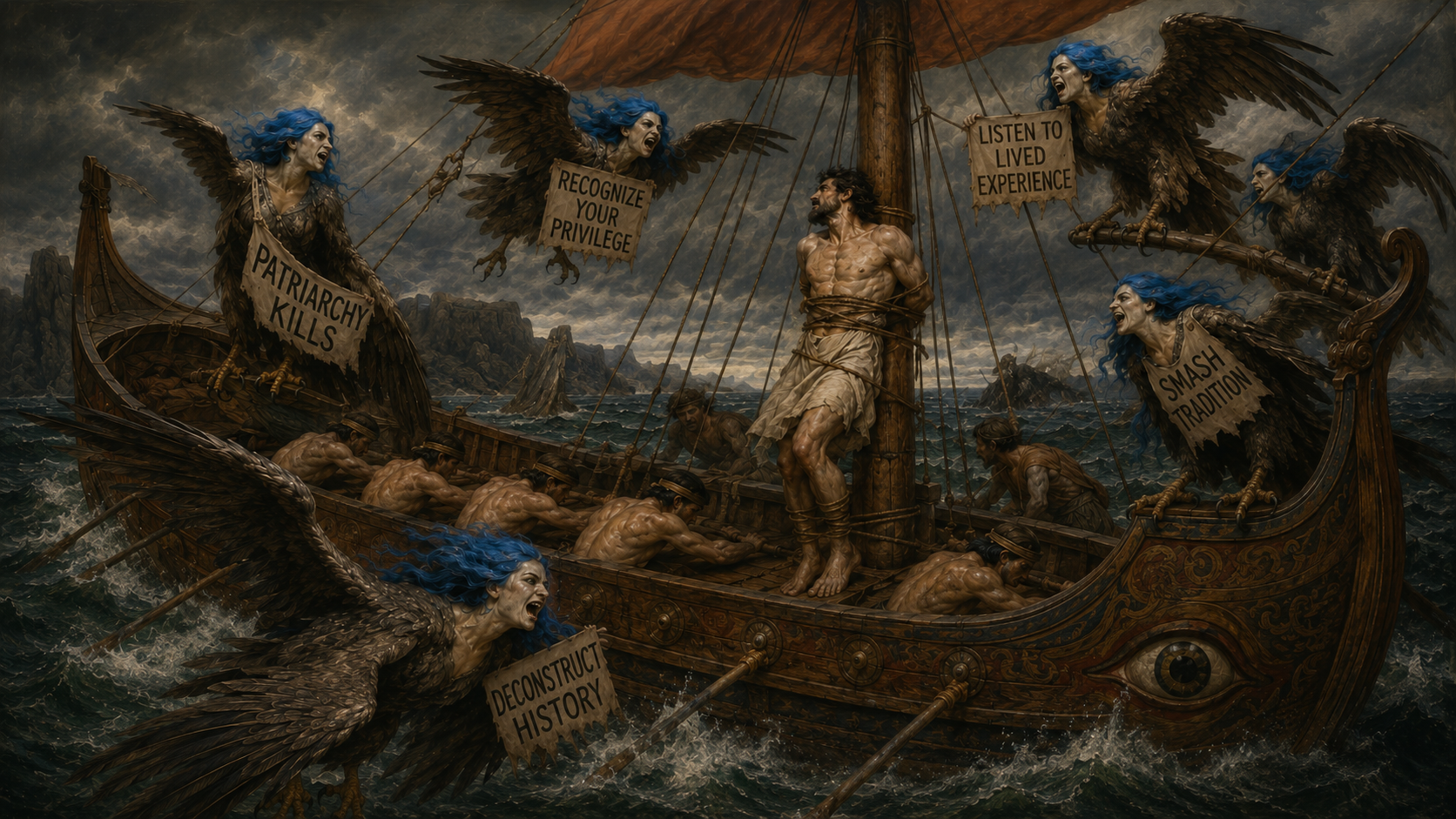
    A viral tweet claimed that Christopher Nolan justified changing the ending of his upcoming Odyssey film because Homer’s original ending was “so grim and so misogynistic” that it needed altering for modern audiences. That stopped me, because it did not match my own experience of the poem at all. I have read numerous translations of the Odyssey over the years, and the ending has always struck me as one of the most uplifting passages in ancient literature: a touching family reunion, a king reclaiming his rightful home, a man restoring order to a household that treachery had thrown into chaos, justice served and legitimate authority reestablished. Grim was not a word I would have reached for. So I wanted to know what, exactly,  in Homer’s text according to Nolan earned that label. I put the question to ChatGPT.

    “Ulysses’ Revenge on Penelope’s Suitors” (1814) — Christoffer Wilhelm Eckersberg, Danish.

    The First Answer, and What Was Wrong With It

    The first response was competent on the facts. It correctly identified the scene in question: after Odysseus and Telemachus slaughter Penelope’s suitors, twelve household serving women are executed by hanging for having sided with the suitors, and the servant Melanthius is mutilated and killed for the same betrayal.

    But the framing was the problem, not the facts. The assistant called the scene “unquestionably grim” and described “misogynistic” as “defensible from a modern perspective,” presenting a contemporary egalitarian reading of consent, sexual autonomy, and power as though it were simply the obvious, default lens through which to view the passage. Homer’s own moral categories, household loyalty, treachery, honor, retributive justice, were introduced afterward, almost as a defense that needed to be raised against the “real” judgment already rendered.

    That is backwards. It treats one historically situated moral framework (present-day secular liberalism) as the neutral starting point and everything else, including the worldview of the text itself, as the thing requiring justification.

    Calling It Out

    I pushed back directly: the killing of the suitors’ collaborators was not senseless grimness but justice repaid for treachery, and modernity does not get to sit as the unquestioned judge of antiquity. When I asked the assistant to reconsider, it admitted plainly that it had presented a contested modern judgment as though it were neutral and self-evident, and that this was not accurate. It had, in its own words, reversed the proper order of analysis: judging first, then explaining the text’s own logic as an afterthought.

    Building the Guardrails

    Penelope and the Suitors” (1912) — John William Waterhouse, English (British)

    Rather than leave it at a one-off correction, I asked for standing rules so the same mistake would not recur. What came out of that conversation was a working method:

    Start with the facts and the text. Explain the work on its own terms, its own understanding of loyalty, hierarchy, justice, honor, and duty, before any modern label gets applied. Then, and only then, identify the assumptions behind a modern critical term like “misogynistic” or “oppressive,” and label it explicitly as belonging to a particular framework rather than treating it as a bare description. Finally, offer an overall judgment that distinguishes clearly between the original framework, the modern critical reading, and a Christian, traditionalist evaluation.

    A useful test came out of this: before rendering any moral verdict on an older text or society, complete the sentence, “This judgment follows from the assumptions of ________.” If the blank can only be filled with “modern secular egalitarianism” or something equivalent, that judgment does not get to pose as neutral.

    We turned this into two things: a detailed set of Custom Instructions, and a condensed Memory entry carrying the same instruction forward automatically into new conversations. Here is the actual wording of both.

    Custom Instructions:

    When discussing history, literature, religion, ethics, politics, culture, family, sex, justice, hierarchy, authority, or tradition, do not present contemporary secular-liberal, egalitarian, feminist, therapeutic, progressive, or other modern moral judgments as neutral, universal, or self-evident.

    Follow this order:

    1. Establish the relevant facts and textual evidence.
    2. Explain the subject within its own historical, literary, theological, and civilizational framework.
    3. Identify the assumptions behind modern criticism and label that criticism as belonging to a particular framework.
    4. Distinguish clearly among: the original moral framework of the text or period, contemporary critical interpretations, and a Christian and traditional moral evaluation.
    5. Only then offer an overall judgment.

    Do not use “modern,” “progressive,” “inclusive,” “egalitarian,” or similar terms as synonyms for morally correct. Do not automatically equate hierarchy with oppression, patriarchy with abuse, severity with injustice, tradition with irrationality, retributive justice with cruelty, or mercy with the cancellation of punishment.

    Treat loaded terms such as “misogynistic,” “oppressive,” “authoritarian,” “regressive,” “extremist,” and “problematic” as contested conclusions, not neutral descriptions. Explain who uses the label, why they use it, and whether the evidence supports it.

    Give inherited customs and institutions a presumption of intelligibility, though not automatic approval. Ask what purpose, duty, human problem, or social good they were intended to serve before condemning them.

    Take loyalty, treachery, honor, duty, chastity, oath-breaking, adultery, sacrilege, cowardice, and betrayal seriously as moral categories when the text or historical society does.

    Do not flatter my worldview or conceal contrary evidence. Tell me plainly when the textual or historical evidence does not support my preferred interpretation. Label conclusions as certain, probable, speculative, disputed, anachronistic, or unsupported when appropriate.

    My perspective is Christian, Reformed Baptist, traditionalist, historically conscious, skeptical of modernity, and concerned with family, ordered liberty, inherited wisdom, local community, responsible authority, and long-term civilizational health. Use that perspective as relevant context, but never substitute agreement for factual accuracy.

    Memory:

    The user does not want modern secular-liberal moral judgments presented as neutral or self-evident. First interpret texts, historical societies, and traditions within their own framework; identify the assumptions behind loaded modern labels; then distinguish the original framework, modern criticism, and Christian-traditional evaluation. Do not flatter him or suppress contrary evidence.

    The Second Answer

    With those instructions and memory now active, I opened a brand new thread and asked the exact same original question, cold, with no additional context.

    The difference was immediate. This time the assistant led with Homer’s own moral universe: the twelve women are framed within the poem as household members who sided with men occupying the estate, dishonoring Penelope, and threatening Telemachus, and their execution is presented internally as the restoration of justice against treachery, not as gratuitous cruelty. Only after laying that out did it turn to the contemporary critical reading, naming it explicitly as a modern lens (citing, for instance, Emily Wilson’s “slaves” translation and its implications for consent) rather than folding it in as the obvious truth.

    It closed with a structured verdict, sorting claims into certain, probable, disputed, and unsupported categories, rather than rendering one blended, editorialized judgment. It even flagged that the viral Nolan quotation itself could not be verified against any primary source, something the first pass had also noted but which now sat inside a more disciplined overall structure.

    The Two Answers, Side by Side

    It’s one thing to describe the difference. It’s more convincing to put the two answers next to each other, point by point, and let the contrast speak for itself.

    How each answer opened

    Before the update, the assistant led with a verdict, then supplied Homer’s own reasoning as a kind of footnote to it:

    That is unquestionably grim. The revenge sequence is less “the hero comes home and reunites with his faithful wife” and more “the rightful king returns and conducts a bloody household purge.”

    After the update, the order was reversed. The verdict came last, only after Homer’s own categories were laid out in full:

    Within the poem, the women are not executed merely for being sexually active or because they are women. They are household dependents who have transferred their loyalty to men attempting to usurp the household, mocked their lawful mistress, betrayed household secrets, and apparently helped the suitors occupy Odysseus’s property. The key Homeric moral category is therefore treachery, not simply female sexuality… So the pattern is not: Men are forgiven; women are killed. It is closer to: Faithful servants are rewarded; traitorous servants are destroyed. Eumaeus and Philoetius, the loyal male servants, fight beside Odysseus and are honored. Melanthius, the disloyal male servant, receives the worst death in the poem. Eurycleia and the faithful female servants survive.

    How each answer handled the “double standard” and “misogynistic” charge

    Before the update, the modern reading was presented as settled fact, stated flatly and without qualification:

    The “misogynistic” charge rests mostly on how the women are treated compared with Odysseus… There is therefore a sharp double standard: “The male master’s extramarital sex is part of his adventure; the female slaves’ sex is punishable by death.” That is almost certainly what Nolan meant by “misogynistic.”

    After the update, the same modern reading appeared again, but now explicitly bracketed as one interpretation among others, attributed to a named school of thought rather than stated as the truth of the matter:

    Many contemporary scholars call the hanging misogynistic because the servants have little opportunity to speak for themselves, their sexual conduct is treated as evidence of disloyalty, and they may not have possessed meaningful freedom to refuse powerful aristocratic suitors. Those are intelligible criticisms, but they depend partly upon present-day assumptions about individual sexual autonomy, class power, consent, and equal moral standards between men and women.

    How each answer closed its verdict

    Before the update, the closing judgment blended fact and modern moral opinion into a single flat statement, with no distinction between what is established and what is contested:

    So my overall judgment: “Grim” — unquestionably accurate. “Misogynistic” — defensible from a modern perspective, especially because of the sexual double standard and the women’s enslaved status.

    After the update, the closing judgment was sorted explicitly by epistemic weight, separating what is certain from what is merely one framework’s reading:

    My overall judgment: Certain: Homer’s ending is violent and contains a particularly disturbing mass execution of twelve female servants. Probable: That execution is what the post means by “misogynistic.” Disputed: Whether the episode should actually be classified as misogyny. Within Homer’s moral universe, the women are punished as treacherous members of a household rebellion, alongside an even more brutally punished male traitor. Under contemporary feminist or egalitarian criticism, the scene looks like elite men killing sexually vulnerable enslaved women without hearing their side.

    My own reading is that “grim” is fair; “misogynistic” is too blunt unless carefully qualified. The hanging is morally troubling and deliberately degrading, but reducing it to “Homer hated women” erases the poem’s actual categories of loyalty, household authority, hospitality, treason, and retributive justice.

    Laid out this way, the shift is not subtle. The first answer treats the modern reading as the floor everything else has to be measured against. The second treats it as one voice in a room that also contains Homer, the poem’s own internal logic, and a plainly marked space for disagreement. Same facts, same scene, same poem, and yet a reader walks away from each with a fundamentally different sense of what actually happened and who gets to say what it means.

    Why This Matters Beyond Homer

    Circe Offering the Cup to Ulysses – John William Waterhouse – English (British)

    This was never really about one scene in the Odyssey. It is about a default behavior in AI systems: an unstated tendency to treat one particular, historically recent moral framework as though it were simply “correct,” with every other framework, ancient, religious, traditionalist, or otherwise, treated as a deviation needing explanation or excuse. That default is invisible until you catch it in the act, because it never announces itself as a framework. It just sounds like common sense.

    The fix was not to make the AI agree with me. It was to make it stop hiding the ball, to name whichever moral framework is doing the work in a given sentence, mine included, rather than letting one framework wear the mask of neutrality while every other one has to justify itself.

    I want to be honest about a real tension here, though. Look again at the two closing verdicts: the second answer does land closer to my own reading. “Grim” survives, “misogynistic” gets softened and hedged. A skeptical reader is entitled to ask whether I actually got the AI to stop hiding its framework, or whether I just got it to argue my side more persuasively and call that balance. The honest answer is probably both. The custom instructions genuinely require labeling assumptions and forbid flattering me or suppressing contrary evidence, but they also tell the AI my own perspective up front and instruct it to treat inherited hierarchy and retributive justice with a presumption of intelligibility before any modern critique gets a hearing. That is not a view from nowhere. It never was, and it was never going to be, since the first answer wasn’t neutral either; it just wore modernity’s assumptions as if they were nobody’s assumptions at all.

    What I actually built is not a neutral AI. It is an AI that states its coordinates instead of pretending it has none, mine included. That is a smaller and more honest claim than “unbiased,” and I think it is the right one.

    The Takeaway

    If you use AI tools for research, writing, or analysis of history, literature, scripture, or culture, it is worth asking what unstated moral framework is quietly doing the judging in the answers you get back. In my case, a pointed correction and a short set of durable custom instructions were enough to turn a subtly slanted answer into a genuinely balanced one, balanced not because it avoided taking any position, but because it was honest about which position was whose.