
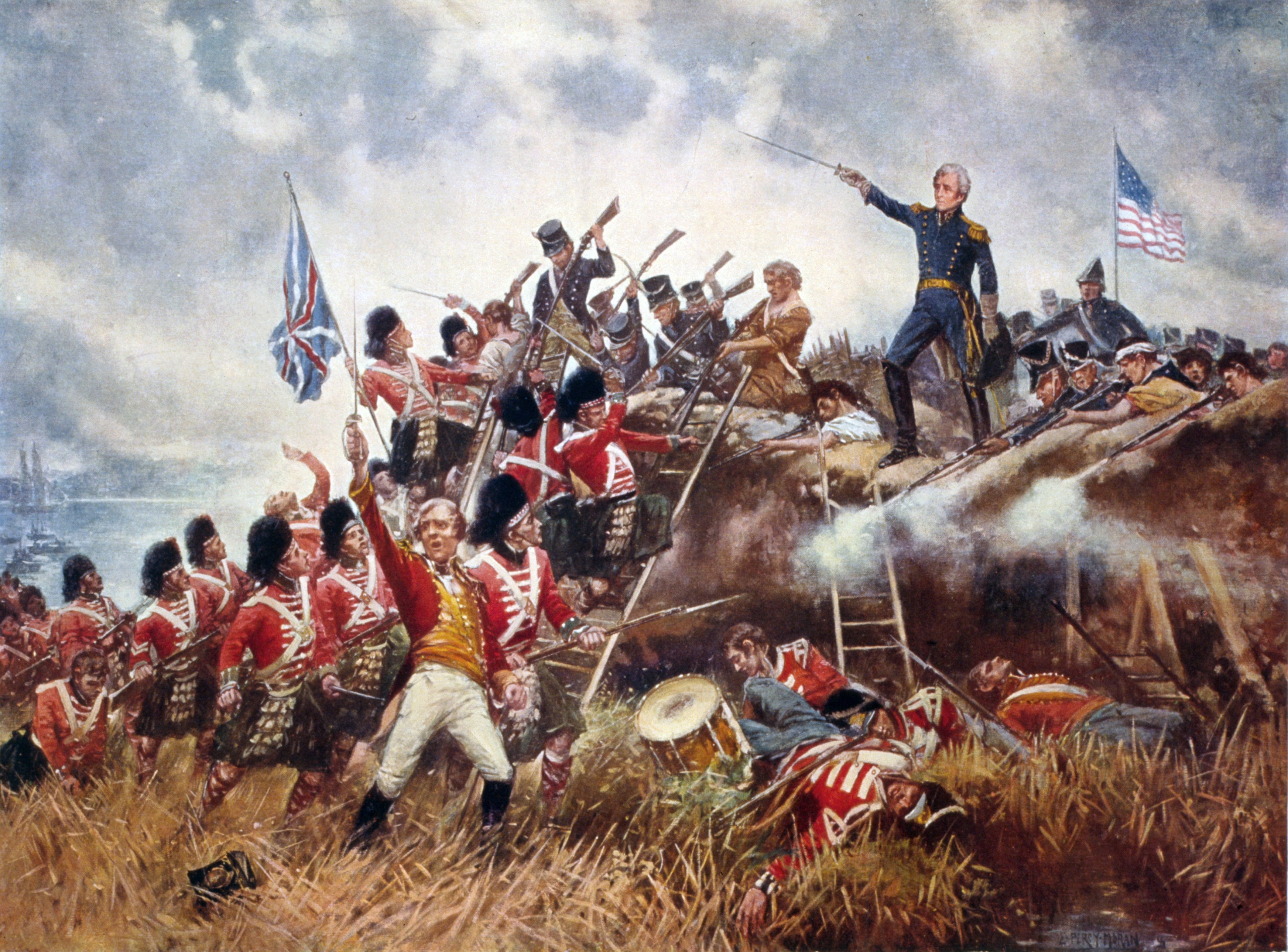
The Battle of New Orleans was fought on January 8, 1815 between the British Army under Major General Sir Edward Pakenham and the United States Army under Brevet Major General Andrew Jackson, roughly 5 miles (8 km) southeast of the French Quarter of New Orleans, in the current suburb of Chalmette, Louisiana.
The battle was the climax of the five-month Gulf Campaign (September 1814 to February 1815) by Britain to try to take New Orleans, West Florida, and possibly Louisiana Territory which began at the First Battle of Fort Bowyer. Britain started the New Orleans campaign on December 14, 1814, at the Battle of Lake Borgne and numerous skirmishes and artillery duels happened in the weeks leading up to the final battle.
The battle took place 15 days after the signing of the Treaty of Ghent, which formally ended the War of 1812, on December 24, 1814, though it would not be ratified by the United States (and therefore did not take effect) until February 16, 1815, as news of the agreement had not yet reached the United States from Europe. Despite a large British advantage in numbers, training, and experience, the American forces defeated a poorly executed assault in slightly more than 30 minutes. The Americans suffered just 71 casualties, while the British suffered over 2,000, including the deaths of the commanding general, Major General Sir Edward Pakenham, and his second-in-command, Major General Samuel Gibbs.
Leave a Reply