
Roanoke, 13 July 1584, and what the colonists chose to leave
On the thirteenth of July, 1584, a boat’s crew of Englishmen waded ashore on a sandbank off the coast of what is now North Carolina, read a formula aloud, and took possession of the country in the name of Elizabeth of England.
There was no one there to hear it. The ceremony was performed, as Arthur Barlowe carefully noted, according to the forms proper to such enterprises. Which is to say that a handful of wet men in a howling emptiness of sand and grapevines went through the motions of a legal act, addressed to a queen three thousand miles away and to a God they assumed was listening. Then they climbed the dunes, looked at the sea on both sides of them, and understood, slowly, that they were not on the mainland at all.
That was the beginning of English America. Not Jamestown. Not Plymouth. Two small barks, their crews, and a claim staked on a barrier island by people who did not yet know it was an island.
They had left Plymouth in April under Philip Amadas and Arthur Barlowe, sent out by Walter Raleigh, who held a patent from the Queen and had no intention of going himself. He was not yet Sir Walter. The knighthood came the following January, and Elizabeth kept her favourites where she could see them. The voyage was a reconnaissance and nothing more: look at the land, meet the people, come back and tell us whether a colony can live there.
Barlowe came back and told them yes, in prose that reads like Eden with a coastline. Soil the sweetest in the world. Cedars taller and redder than any in Europe. Grapes so thick on the ground that the surf itself broke over them. Deer, hares, fowl, fish, in incredible abundance. And a people, the Algonquian-speaking Secotan, whom he described as gentle, faithful, void of guile, living after the manner of the golden age.
Two of them came home with him: Manteo, a Croatoan, and Wanchese, of Roanoke. England had found its Virginia, named for the Virgin Queen. The name meant not the modern Commonwealth but the whole vague immensity of the claim, everything between Spanish Florida and the ice.
Here is what Barlowe left out, and it is the fact on which everything afterward turns.
The Secotan were in a dry season and had no surplus. The people who welcomed Barlowe with such generosity were not living in a garden. They were living close to the bone, in a bad year, with nothing to spare, and they gave to strangers out of a poverty the strangers mistook for plenty.
Barlowe wrote a prospectus. Raleigh read it as a survey. Everything that followed was built on the difference.
The next spring Raleigh sent six hundred men in seven vessels under Sir Richard Grenville, and left about a hundred of them on Roanoke Island under Ralph Lane, a soldier out of the Irish plantations. This is the colony people confuse with the Lost Colony, and it was nothing of the kind. It was a garrison.
There were no women. There were no children. There was no plough worth the name. What Lane built was a fort with a privateering base attached: somewhere to lie in wait for the Spanish treasure fleets, and to dig, hopefully, for copper. Almost at the outset the flagship Tiger grounded in the shoals and the sea got into her hold, and most of the food the expedition had carried across the Atlantic was ruined in a single afternoon. From that moment the colony was a hundred armed men living on the charity of neighbours who were themselves starving.
What followed has the terrible logic of every such story. A silver cup went missing at the town of Aquascogoc, and Grenville burned the town and its standing corn over it. Through the winter Lane’s men leaned harder and harder on villages that had nothing to give. And in June of 1586 Lane decided that the chief Wingina, who had by then taken the name Pemisapan, was conspiring against him. He crossed to the village under a flag of parley and had him killed. They took his head.
Days later Francis Drake’s fleet appeared off the coast, fresh from burning the Caribbean, and Lane’s colonists went aboard and sailed home to England. A relief squadron under Grenville arrived shortly after to find the fort empty. He left fifteen men to hold the place, because a claim unheld is a claim abandoned, and sailed away.
Those fifteen men were never seen again by any Englishman. They are the first English dead of the American story, and no one remembers their names, because they are not the mystery. They are only the cost.
What makes Roanoke worth an evening of your attention is that England tried again, and tried differently.
In 1587 John White came back. He was the artist, and his watercolours of Algonquian towns and dances and fishing weirs remain the truest window any European has left us onto that world before it was destroyed. This time the passengers were not soldiers. There were about a hundred and fifteen of them: men, women, children, tradesmen with their families, people who had sold what they had in England and did not intend to come back. They were bound for the Chesapeake, for deep water and good soil. Their pilot, Simon Fernandes, refused to carry them further. He put them off at Roanoke, the one place on that coast where the English name was already a curse, and sailed away to hunt Spanish prizes.
They did not know what they were walking into. Tree-ring records recovered from the region tell us now what nobody could have told them then: the three years beginning in 1587 were the driest that coast had seen in something like eight centuries. The families of the second colony stepped ashore into the worst drought in the memory of anyone living, and of their grandparents, and of every generation back beyond the Conquest. They had come to farm.
They made the best of it. On the thirteenth of August, Manteo, the Croatoan man who had crossed the ocean twice and come back both times, was baptised into the Church of England and made Lord of Roanoke: the first American, so far as we know, brought to the font in the English rite. Five days later White’s daughter Eleanor bore a girl, and they christened her Virginia, the first English child born in this hemisphere, named for the Queen and for a country that did not yet exist except as a hope and a charter.
Set those two sacraments side by side, five days apart on a sandbar, and you can see what was finally being attempted. Not a fort. Not a mine. A font and a cradle. A parish.
It lasted a month. The colonists pressed White to sail for supplies, and he went, and then the Armada came and England had not a ship to spare for anything, and by the time he clawed his way back it was August of 1590. Three years.
He found the settlement dismantled, not burned. Houses taken down, timbers stacked. A palisade thrown up. And carved into one of the posts, in fair capitals, a single word:
CROATOAN
Nothing else. No bodies. No graves. On a nearby tree, three letters: CRO.
Here is the detail that stops me, and it is why I wanted to write about this at all.
Before he left in 1587, White and the colonists had agreed a code. If they moved, they would carve the name of the place they had gone to. And if they were driven out, if they left in distress, under attack, in fear, they would cut a Maltese cross above the name.
There was no cross.
Whatever happened on that island, the people who left it took the trouble, in what may have been their last hour there, to tell a man three thousand miles away and three years in the future that they were not afraid. They pulled their houses down like people with time. They stacked the wood. They carved the word. And they withheld the sign that would have said this ended in terror.
We do not know that it was true. It may have been a lie told in kindness, or an act of faith, or an old discipline holding to the end. But it is what they chose to leave, and choosing what to leave is the last freedom anyone has.
A storm blew up before White could reach Croatoan Island. He was driven back out to sea. He never landed in America again, and he died in Ireland without ever learning what the word meant.
The Christian imagination ought to be at home with a mystery of this shape: an emptied settlement, no body, and a message from people who had gone somewhere else. I will not press the analogy, because it breaks if you lean on it. The tomb was empty in triumph and Roanoke was empty in silence, and only one of those is good news. But the pattern is one a Christian should recognise. Absence is not the same as annihilation. And the sign we are given is almost never the sign we asked for.
What became of them, I will not pretend to know. The likeliest reading is the dullest and the kindest: that they went south to Croatoan, or west up the sounds, and were taken in, and married, and were absorbed, and their grandchildren spoke Algonquian and did not know the Creed. Twenty years later at Jamestown, Powhatan was reported to have told the English that he had killed them, but that reaches us thirdhand and will not bear much weight. There are tales of grey-eyed Indians and English-built walls. There is a great deal of archaeology and very little of it conclusive.
Choose your theory. It will tell you more about yourself than about them.
Which is precisely the trouble with the Lost Colony. A people who vanish become useful in a way the living never are. They can be made to say anything, because they said only one word, and left it on a post. CROATOAN has been carved into television scripts and paperback covers until it means nothing but spooky, and the dead cannot object.
But I want to come back to the child, who deserves better than she has had from us.

Virginia Dare was born on the eighteenth of August, 1587, on an island her parents had not chosen, in a colony that every soul aboard knew had been put ashore in the wrong place. Her mother was Eleanor White, far from her own mother. Her father was Ananias Dare, a tiler and bricklayer of London: a tradesman, a man who worked with his hands, exactly the sort of man the first colony had conspicuously lacked. Her grandfather was the governor, and he was also the artist, and the fact that we can see the Algonquian world at all is because he sat down in front of it with a brush.
She was christened the Sunday following her birth. Nine days after she was born, her grandfather sailed for England to fetch supplies, meaning to be back inside the year.
And that is everything. That is the whole of what is known about Virginia Dare: a birth, a font, a family, nine days.
Which is, in fact, rather more than most people got in 1587, and it is enough. The reverent thing is to stop there. Everything that comes after is not about her: the pageants, the marble, the slogans, the men who needed a founding mother and did not much care who she actually was. It is about us, ventriloquising a baby because she cannot contradict us. She is not a symbol of anything. She was a daughter.
But there is one thing more, and it is the only claim I will make about her with any confidence at all.
The Church has a word for what happened to that child on that Sunday, and the word is not lost. Baptism is a naming. It enters a name in a book that we do not keep, cannot edit, and are incapable of losing. The charts, the watercolours, the muster rolls, the word on the post: of every record made at Roanoke, that is the only one that has not decayed. We do not know what became of Virginia Dare. We know Whose she is.
That is not a consolation prize offered in place of history. It is a harder and stranger claim than any theory about Hatteras or the Chesapeake, and it is the one the colonists themselves would have recognised. They carried the Prayer Book across three thousand miles of ocean because they believed it. It is why there was a christening on that island at all.
It is tempting to file all of this as a strange prologue to Jamestown: the colony that failed, before the colony that worked. But nobody living through it knew there would be a Jamestown. The men who waded ashore in 1584 did not know whether England would ever hold a foot of that coast. The soldiers of 1585 did not know their fort would be abandoned inside the year. The families of 1587 did not know their names would survive only as a riddle.
They stood at the beginning of something whose end they could not see, and they acted within the limits of what they knew, sometimes nobly, often wickedly, and almost always without understanding what they had set in motion. That is worth holding onto the next time some institution looks to you inevitable. Everything solid was built by people with no guarantee of anything.
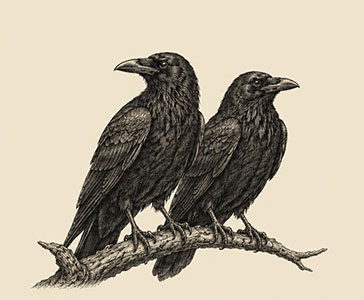
Two ravens sit on the god’s shoulders in the old poem, and he says he fears more for the loss of Memory than for the loss of Thought. He is right to. Thought can be rebuilt; you can reason your way back to an argument you have mislaid. Memory cannot. When it goes, it takes the names with it: the fifteen men Grenville left on the island, the parishioners of the first English parish in America, the girl who was christened on a sandbar and then walked out of the record and into the keeping of someone better at remembering than we are.
What we owe them is not an explanation.
It is only to keep saying the word.
A note on the date: July 13, 1584 is Old Style, as all English dates are before 1752; by our calendar the landing fell nearer the 23rd. The anniversary is conventionally kept on the 13th, and I have kept it there. Where exactly Amadas and Barlowe came ashore is disputed. Hatteras, Ocracoke, and the inlet near present-day Oregon Inlet all have their advocates.
Leave a Reply