The Men Who Leave No Record: On Clint Bentley’s Train Dreams
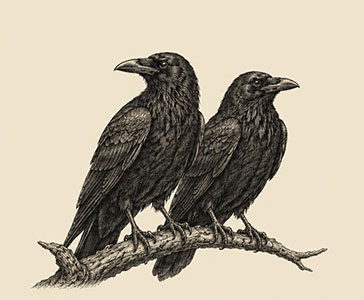
Odin kept two ravens. Huginn went out over the world and brought back thought; Muninn brought back memory. The old poem has the god confess a fear: that one day the birds will not return. He worries more, he says, for Memory.
I have named this place after those birds because I believe that fear is the correct one. A civilization does not usually die of an argument lost. It dies of a thing not brought back.
Which is the only frame I can find for Train Dreams, a film about a man who would not have been brought back by anyone.
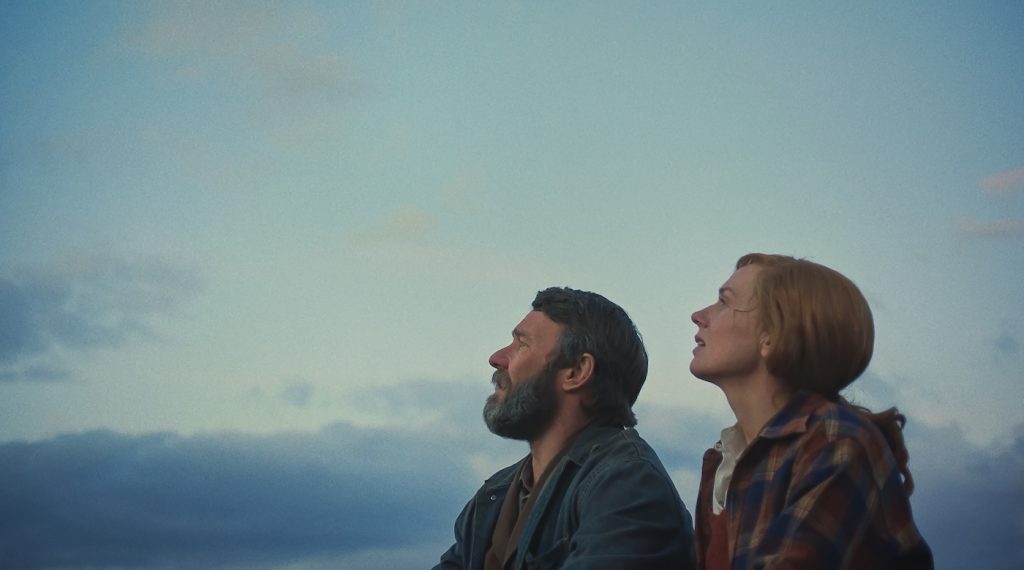
Robert Grainier is an orphan, a day laborer, a logger, a hauler, a husband, a widower, and finally a hermit in a cabin he built twice on the same ground. He fells the timber and lays the grade that make the modern country possible, and the modern country does not know his name. Joel Edgerton plays him with a stillness that is not stoicism in the posed, Instagram sense of the word, but something older and less flattering: a man who does not have the words, and does not know that he is supposed to want them.
Denis Johnson wrote the novella. Clint Bentley and Greg Kwedar adapted it, and Will Patton speaks the narration over it, and the narration is the point. There is no one inside the film to tell Grainier’s story. He tells it to no one. Someone from outside has to fly over the whole life and come back and say what was there. That is a raven’s work. The film is an act of memory performed on behalf of a man nobody remembered, and I want to say plainly that this is a masculine piety and not a sentimental one. The duty to name the dead who built the thing you are standing on is not nostalgia. It is a debt.
I. The love that does not explain itself
Grainier loves by working.
He meets Gladys. He courts her, barely. They walk out to a piece of ground above the river and lay stones on the dirt to mark where the walls of the house will go. That is the vow. Not a speech. A floor plan in rocks. Then he leaves, because the work is where the money is, and the money is what the house is made of, and he comes back, and he leaves again, and each departure is an act of love that looks from the outside exactly like an absence.
Our culture has no category for this. We recognize interiority only when it is performed: spoken aloud, processed, shared, named. A man who does not narrate himself is assumed not to have a self. Grainier is a standing refutation. He has an inner life of enormous depth, and the film knows it, and it never once makes him say so, and it never once punishes him for the silence.
There is a hardness in this that I do not want to sand down. The provision is real and the absence is also real, and the film is honest enough to let the bill come due. But it does not sneer. It does not treat his reticence as pathology. It treats it as a form, a way of being a man that was normal for ten thousand years and has been made illegible in about fifty.
Understand, though, what it means to be built this way. Gladys is not a part of his life. She is the center of it, the thing the rest is arranged around, and Kate is that love made visible, the proof of it walking around on the floorboards of a house he built with his hands. He does not say any of this. He does not have to. Every departure says it.
Which means the whole structure is load-bearing on two people.
II. Arn Peeples, who saw it
And then there is Arn Peeples.
William H. Macy plays him: an old powder man, an explosives hand, the one who blows the stumps and the rock. Consider what that means. The man whose trade is detonation is the one character in the film who sees. He is full of talk and tall stories and complaint about how much harder the work was when he was young. And he is also the one who says the thing nobody else in that camp will say: that these are trees which were standing when Jesus walked the earth, and that cutting them hurts a man’s soul.
He is right. It is a genuinely theological claim, made by a man with no theology. Arn has the sacramental instinct without the sacrament. He knows the world is charged. He knows the trees are older than the Church and that this ought to weigh on a man. He has no vocabulary for why, and no altar to bring it to, and so he carries it around a logging camp in the form of stories and wonder and an old canvas tent that outlasted the army it was made for.
Then a limb comes down on him, and in a few days he is gone.
The crew buries him. Elsewhere in the film, dead loggers are marked with a pair of boots nailed to a tree, which is, when you sit with it, a real epitaph, and the only one the woods can spell. And later, when a man named Billy asks Grainier whether he has seen Arn lately, Grainier, who watched him die, cannot say it. He says he has not seen him. He lies, because the truth will not come up out of him.
That is the whole tragedy of the man in one exchange. He cannot even bury his friend in speech.
Arn dies seeing the beauty of it all. Hold onto that. It comes back.
III. The line that ends
He comes down out of the woods from what was supposed to be his last season. They had made a plan, he and Gladys. Farm the ground. Build a small mill. Stop going away. He is walking home to begin it.
The cabin is gone. The valley is burned black. Gladys and Kate are not found.
Now understand what that does to a man who loves by working.
Work of his kind is not a thing in itself. It is a thing aimed. It is only intelligible as an arrow, and the arrow was pointed at a farm and a mill and a daughter’s future, and there is no longer anything at the far end of it. He goes on cutting and hauling for a while, because a body must eat. What he stops doing is going anywhere. The stream of his life, which had been running hard, simply stops running and stands. He rebuilds the cabin on the same scorched ground and he stays there, alone, for decades, and he becomes a recluse in the middle of his own biography.
We have an enormous vocabulary for grief now, and the film uses none of it. What it shows instead is subtraction. Every year that passes is a year in which nothing is added.
And here is the wound I keep returning to, which I think is the specifically masculine one in the picture: a man builds in order to hand on. That is what the building is for. Grainier did not lay those stones on the ground above the river for himself. He laid them for a wife, and then for a daughter, and beyond her for people he would never meet, who would carry his name and his blood and perhaps his trade into a century he would not live to see. The cabin was a wager on the future. The mill was a wager on the future. Every hour he spent away from his family, breaking his body in the timber, was a wager on the future.
Kate dies a small child, and the future closes.
Not his happiness only. His line. Everything behind him, every forebear whose name he never knew, every hard passage some ancestor survived so that Robert Grainier could exist at all, arrives at a man sitting alone in a burned valley, and stops there. He is the last of them. The film is quiet about this because he is quiet about it, but it is in every frame of the final hour. He has become a terminus.
There is no grandson anywhere on this earth to say my grandfather laid that grade.
IV. What he was given
And yet the film does not leave him in the ashes, and I want to be fair to it, because it gives him more than I first allowed.
Late in his life a young woman comes out of the woods, feral and wordless, and he takes her in and tends her. And the film lets us feel, without ever once telling us, that she is Kate. It will not confirm it. It refuses to adjudicate. What it hands us is the experience of reunion while declining to say whether the reunion happened on the ground or only inside a grieving man, and I have come to think that refusal is the most merciful decision in the picture. To a man who has grieved that long, the distinction has stopped being load-bearing. He cared for a lost daughter. He got to be a father one more time. It was enough.
And afterward, in a scene that is more plainly a dream, he is with Kate as a little girl again, and they play.
I do not read this as delusion, and I do not think the film reads it that way either. I read it as closure, granted to him in the only form he was capable of receiving it, by a story that has decided to be kind to him where his life was not.
Something loosens in him after that. He is old now, out of step, useless to the new machines, a relic in his own valley. And he begins to look again. The world starts handing him astonishments, and he takes them, one after another, with an openness he has not had since he was a young man walking into the timber for the first time.
Which is to say: at the end of his days, Robert Grainier finally sees the beauty of it all.
Now go back to Arn Peeples and see what has happened. The old powder man who loved the trees, who told him the wood was older than Christendom and that cutting it costs a man something, who went out of the world with his eyes open on a thing he found marvelous. Grainier has no son. His name goes nowhere. But he does inherit something, and it is Arn’s, and it is his eyes.
That is the only legacy in this film. It passes between two childless working men at a campfire, and it is everything either of them had to leave.
V. The confession that no one can hear
Which brings me to the scene I cannot get out from under.
Because before Arn dies, Grainier asks him the question.
Years earlier, on a trestle, Grainier watched a crew of men seize a Chinese laborer named Fu Sheng and carry him up to the bridge and throw him off it. He asked what the man had done. Nobody answered him. He did not join it and he could not stop it, and Fu Sheng went into the gorge, and Grainier has been seeing him ever since at the edges of firelight.
Sit with what that means, because I got it wrong the first time I tried to describe it. He is not guilty of murder. He is not guilty of anything a court would recognize. He was a bystander, and he was helpless, and he carries the thing for the rest of his life regardless. That is the particular torment of the man who only watched. He cannot even establish whether the weight crushing him is properly his.
So he comes to Arn, the old man, the one he trusts, the one who sees, and he asks him whether the bad things a man does follow him through his life.
And Arn tells him the truth, which is that he does not know. He has seen bad men raised up and good men brought to their knees.
It is a confession. Everything is there. The penitent. The sin disclosed. The word sought. Everything except an answer. Grainier goes to the wisest man he knows and asks to be told the state of his soul, and what he receives is an honest, kindly, decent shrug. Arn has nothing to tell him. He can only report that he has watched the ledger come out crooked more often than not, which is observant, and true, and no earthly help at all to a man who is drowning.
So the guilt stays in him. And when the fire comes up the valley and takes Gladys and Kate while he is away earning their living, he reads it as the account being settled. The curse coming home. What else is he to think? Nobody ever told him otherwise. Nobody had standing to.
This is what the film understands better than perhaps it intends to. Its world is full of holiness. The trees, the light, the fire, the animals, the beloved dead who come back to the cabin door. There is beauty everywhere in it, and there is closure in it, and there is wonder restored at the end of a long life.
There is no forgiveness in it. Not one drop. What the film never says to Robert Grainier, at any point, in any register, is that the debt has been paid by somebody else.
It would be convenient to blame the frontier for that, to say there was no church within a hundred miles of a logging camp. It would also be false. The missions were in that country before Grainier was born. His trouble was never distance. His trouble was that nobody ever preached to him, and so he was left to work the arithmetic of his own guilt alone, with a shrewd and generous old man for a counselor, and no gospel between the two of them.
VI. The ledger he cannot close
Look once more at what he does with the fire.
He reads it as his sentence, and then he serves it. He rebuilds on the burned ground and he stays, and the staying is the punishment, and he keeps at it until he is an old man. He is right about the deeper premise. There is a debt, because he is a sinner. But he is wrong about the charge, wrong about the sentence, and wrong about the currency. What he does not know, because nobody ever told him, is that the debt cannot be paid in the currency he is offering. Sixty years in a burned-over valley will not settle it. Sixty thousand would not. That is the whole terrible arithmetic of a man attempting to atone for himself: the ledger never comes out even, and he goes on paying anyway, because what else is there to do?
He is wrong about the fire besides, in a way the film cannot correct and I think a Christian must. That fire was not his sentence. It was also not an accident. God was not keeping a tally against Robert Grainier and waiting for the wind to shift, and neither was He absent from the burn. The suffering was ordained and it was not retribution, and holding those two truths at once is very nearly the hardest thing our faith asks of a man standing in the ashes of his own house. Grainier was never given the chance to try. He was only ever given the ledger.
The old poem has Odin worried about his ravens, that Thought will not come home and Memory less likely still. It is the right worry, and I hold to it. We owe our dead the return flight. We owe it to the men whose only headstone is a pair of boots nailed to a tree, and to the men whose line ended with them, and this film pays that debt more beautifully than I had any right to expect.
But it is the smaller of the two debts.
Most of us will never build a railroad. What we will do is sit beside men who are keeping a ledger they cannot close, and say nothing, because it would be awkward, or because we assume somebody must have told them by now.
Arn Peeples gave his friend everything he had. He gave him his stories, and his kindness, and in the end he gave him his eyes, and Robert Grainier lived on that inheritance for fifty years in a burned valley and saw wonders by it.
It was not the thing he asked for.
Leave a Reply