European myth, heroic legend, and folk tale
On a Sunday in June 1755, a physician from Lindau named Jacob Hermann Obereit went through the library of the counts of Hohenems, in the Vorarlberg, and found a parchment manuscript of a German poem that no one had read in two hundred years. It was the Nibelungenlied. The poem had been written around 1200 and forgotten by the sixteenth century. Within a hundred years of Obereit’s afternoon in the castle library, Germans were calling it their national epic. A book kept on a shelf had outlasted every reader who had stopped caring about it.
This is the seventh post in a series on building a Western library, set out in Why Build a Library. It follows the Norse shelf, which ended on the stories the peoples of Europe kept after their gods were gone. The master post gave this section its argument in advance. Myth is not the childhood of thought. It is “the form in which a people stores its judgments about courage, loyalty, oath, vengeance, and death,” and a library that holds the histories without the legends “has kept the skeleton and discarded the nerve.”
The oldest of those stories are already on earlier shelves: Homer with the Greeks, the Aeneid and Ovid with Rome, Beowulf, the Mabinogion, and the Táin with the Celts and the English, the Eddas and the Saga of the Volsungs with the North. What remains is the rest of the medieval legend, and a great deal of nineteenth-century work. Much of what Europe knows of its own folk memory was gathered in the century after Obereit, by scholars and collectors who were recovering a nation’s past as well as a people’s stories. That purpose shaped what they kept and how they told it, and the entries below say so where it matters.
Where the Reader Begins
Myths of Greece and Rome, H. A. Guerber
First published in 1893 and in print ever since, a plain retelling of the classical myths “narrated with special reference to literature and art,” as its full title says. It is a schoolroom book, and that is its use: a reader who has it can follow the allusions in English poetry and in any picture gallery. The myths themselves are better met in Homer and Ovid, on the Greek and Roman shelves.
Myths of the Norsemen, H. A. Guerber
The same author’s retelling of the Norse gods and heroes from the Eddas and sagas, published in 1908. It is older and more Victorian than Crossley-Holland’s The Norse Myths on the Norse shelf, and it does not show its sources as carefully, but it gives the stories as the English-speaking world first received them.
Celtic Myths and Legends, T. W. Rolleston
Rolleston’s 1911 retelling puts the Irish cycles and the Welsh tales into a single volume, and it remains the most convenient one-book way into Celtic myth. Read it for the stories; its opening chapters on the Celts as a people reflect the ethnology of its day and have not held up. It belongs beside the Mabinogion and the Táin on the Celtic shelf, not in place of them.
What the Old Gods Were
Myths and Symbols in Pagan Europe, H. R. Ellis Davidson
A comparison of the religions of the Celts, the Germans, and the Scandinavians, working from archaeology, carved images, and the later literature, by the scholar whose Gods and Myths of Northern Europe is on the Norse shelf. Davidson finds the peoples of the north sharing battle-goddesses and protective spirits, holy places, sacrifice, divination, and ideas of the Other World. It is the scholarship the retellings leave out, and the book to read first in this group.
The Lost Beliefs of Northern Europe, H. R. Ellis Davidson
Davidson’s later and shorter study asks what can actually be known of the old belief once it has passed through folklore and Christian tradition. It is a book about evidence as much as about gods, and it is honest about how little survives. Read it after Myths and Symbols, and before Jacob Grimm, below, who first tried to rebuild the old religion out of the same folklore.
A History of Pagan Europe, Prudence Jones and Nigel Pennick
The only book on this shelf to cover the whole of pagan Europe, from Greece and Rome to the Baltic lands, Russia, and the Balkans, ending with the modern pagan revival. It argues, against the Christian reading of European history, that the modern world owes its tolerance, its arts, and its respect for empirical method to the old religions. Its breadth is real, and no other book here reaches the Baltic and Slavic peoples. This shelf reads the evidence the other way: nearly everything known of Europe’s pagan past reached us in Christian hands, and what survived the conversion survived because the Church kept it.
What the Heroes Swore

The Nibelungenlied
The poem Obereit found was composed around 1200 by an unknown poet, probably in Passau. It is the German telling of the story the Norse shelf met in the Saga of the Volsungs: Siegfried’s murder, his widow Kriemhild’s long vengeance, and the destruction of the Burgundians at the court of Attila. No poem in the library puts loyalty under more pressure. Hagen keeps faith with his king to the last, and the last is a hall full of the dead.
The History of the Kings of Britain, Geoffrey of Monmouth
Written in Latin in the 1130s, Geoffrey’s history begins with Brutus, a descendant of Aeneas, founding Britain after the fall of Troy, and hands Lear, Cymbeline, and Arthur to the poets who came after. Very little of it is history. It belongs here because it is where Arthur first becomes a king with a court, a conquest, and a fall, and because Britain believed it for four centuries. Read it beside the Aeneid, whose story it claims to continue.

Sir Gawain and the Green Knight
Written in the late fourteenth century by a poet whose name is lost, and surviving in a single manuscript, it is the finest poem in English about keeping an oath. A green knight offers to take a blow and return it a year later; Gawain accepts the bargain, and keeps his appointment knowing what it will likely cost him. He rides out under a shield with the pentangle on its face and the Virgin painted inside, and the poem tests both the courtesy and the faith they stand for.
Le Morte d’Arthur, Sir Thomas Malory
Finished by a knight in prison around 1470 and printed by William Caxton in 1485, Malory’s book gathers the French and English romances into one long English prose story, from Arthur’s begetting to his death. It is the Arthur English readers inherited. Its subject is divided loyalty: the Round Table is broken not by its enemies but by the claims of love, kinship, and vengeance on the same men, and it ends with the king and nearly all his knights dead.
Where the Gods Went
Gods and Fighting Men, Lady Gregory
Published in 1904 with a preface by Yeats, Lady Gregory’s book retells the Irish stories of the Tuatha Dé Danann, the old gods of Ireland, and of Finn and the Fianna, in an English shaped by the speech of the Galway countryside. It is the tradition in its literary form: the gods as the medieval Irish manuscripts remembered them, already turned into a people who had come before and withdrawn into the hills.
Irish Fairy and Folk Tales, W. B. Yeats, ed.
Yeats’s anthology, first assembled in 1888, gathers the folk form of the same tradition: the trooping fairies, the changelings, the banshee, the stories told at Irish firesides and taken down by nineteenth-century collectors. Beside Lady Gregory it shows the tradition at a lower and more domestic level, where the old gods have become the people of the hills and a family has to be careful of them.
The Fairy-Faith in Celtic Countries, W. Y. Evans-Wentz
Published by Oxford University Press in 1911, from fieldwork in Ireland, Scotland, the Isle of Man, Wales, Cornwall, and Brittany, it records in their own words what country people still said they believed, just before that belief gave way. It is evidence for what his informants told him, not for his conclusions, which go well past what the testimony can bear. Read it last in this group. It shows Lady Gregory’s gods still believed in, after a fashion, centuries after the monks wrote them down.
How the Nineteenth Century Gathered It
Household Tales, Jacob and Wilhelm Grimm
The brothers published a first volume in 1812 and a second in 1815, and kept revising the collection until the seventh edition of 1857. They set out to rescue German folk tradition before it disappeared, and they edited what they rescued, so the tales most readers know are partly Wilhelm’s work. That is no reason to leave them off the shelf. It is a reason to know, when reading them, that the voice is partly a nineteenth-century scholar’s.
Teutonic Mythology, Jacob Grimm
First published in 1835 as Deutsche Mythologie and later translated into English in four volumes, it is Jacob Grimm’s attempt to rebuild the religion of the old Germans from what survived in folklore, custom, place names, and language. It founded the method that most later work, Davidson’s included, has used and qualified. It is a book to consult rather than to read through, and it is best taken beside the Household Tales it drew on.

The Kalevala, Elias Lönnrot
A country doctor who walked the villages of Karelia taking down the songs of the rune-singers, Lönnrot arranged what he collected into a single epic, published in 1835 and expanded to fifty poems in 1849. The Kalevala is therefore both a folk tradition and one man’s composition, and it became the book through which the Finns understood themselves as a nation. The Finns are not an Indo-European people, and the poem’s world of singer-heroes and spells is unlike anything else in the library, which is reason enough to have it.
Wagner’s Ring: Turning the Sky Around, M. Owen Lee
Wagner built his four operas out of the Eddas, the Volsungs, and the Nibelungenlied, and made of them something none of his sources intended. Lee, a priest and a classicist, wrote this short guide from the intermission talks he gave on the Metropolitan Opera’s radio broadcasts, and his title comes from C. S. Lewis, who said that his first meeting with the Ring felt as if the sky had turned round. It is the best brief account of what the nineteenth century made of the northern legends, and of why they mattered so much to it.
The Inheritance
Every story on this shelf reached us by one of two roads. Some were written down in the Middle Ages by Christians who no longer believed in the gods they were describing and kept them anyway, because a people’s memory was worth keeping. Others were taken from the mouths of country people in the nineteenth century by scholars who wanted a nation’s past back. Both roads ran through someone who chose to keep the story, and both left their mark on what was kept.
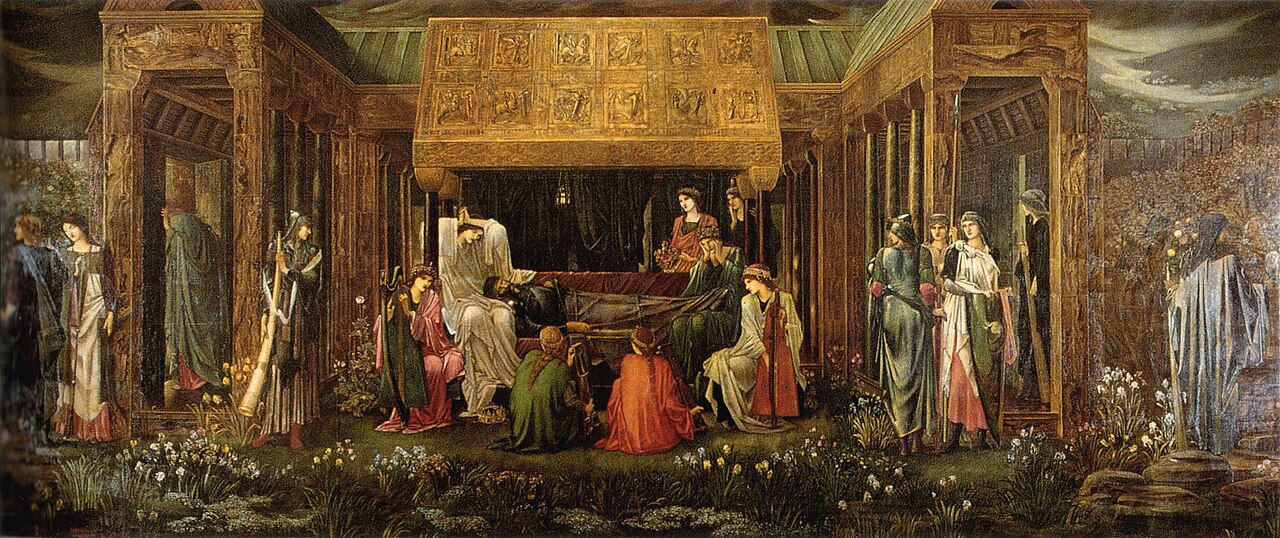
What the legends hand on is the part of a people’s memory the histories leave out: what it admired, what it feared, what a man owed his lord and his kin, and how he ought to die. Hagen keeping faith with Gunther. Gawain riding north to his appointment. Arthur’s last battle by the sea. A reader who knows these stories knows what loyalty costs before he is asked to pay it.
Much of that memory was kept by the Church, which copied the old stories and taught the new peoples to read them. The next shelf turns to Christendom, and to the order that kept them.
Leave a Reply