
A little past midnight, in the small hours of 17 July 1918, Yakov Yurovsky woke the family in the merchant’s house at Ekaterinburg and told them they were being moved for their safety. They dressed. They gathered their few things. Nicholas carried his son down the stairs because the boy could not walk. In a bare basement room they were arranged as if for a photograph: the deposed Tsar, his wife, their five children, the family doctor, and three servants who had refused to leave them. Then Yurovsky read out a sentence, and the men behind him began to fire.
It was not the clean execution the Bolsheviks had imagined. The daughters had sewn diamonds into their bodices, and the jewels turned the first bullets aside, so that what should have taken a moment became some twenty minutes of smoke and screaming and bayonet work in a room too small for it. When it was finished, the bodies were carried out to a forest, stripped, doused with acid, and hidden so badly that it took sixty years and the fall of the regime that ordered it before they were found.
The Bolsheviks had a name for the house where they kept the family in those last weeks. They called it Dom Osobogo Naznacheniya, the House of Special Purpose. I have never been able to shake that phrase. It has the flat, clerical menace that the twentieth century would make its native tongue: the language of men who murder a family of children and file it under logistics.
The clean stroke
Here is the detail I cannot get past: the Bolsheviks meant this to be quick.
Yurovsky had planned an execution, a swift, orderly, almost administrative thing. A room, a squad, a volley, and done; the bodies spirited away and dissolved before morning, the whole business closed like a ledger. What he got instead was the diamonds turning his bullets aside, the room filling with smoke until the killers could not see their own targets, the daughters still alive after the first fusillade, bayonets that would not do the work cleanly, twenty minutes of it, and then a disposal so bungled that the grave had to be abandoned, the corpses moved again, doused in acid, and hidden in a way that kept them lost for sixty years. He wanted a clean stroke. He got a long, botched horror he could neither control nor conceal.
I have come to think that is the truest thing in the whole account, because it is the shape of the entire enterprise in miniature. The revolutionary always promises the clean stroke. That is the pitch, every time: one decisive act, one necessary cruelty, one temporary measure, and the new world is born. The state withers away, the abundance arrives, the old injustices are settled at a single blow, and men are free at last. It is always sold as the quick fix. And it always turns out to be the cellar: the swift measure that becomes permanent, the emergency that hardens into the system, the terror that outlives its own architects, the quick kill that takes twenty minutes and then sixty years and is never as finished as they swore it would be.
War Communism was going to feed the country; it starved it. Collectivization was going to modernize the harvest in a single season; it produced the Holodomor. The state that was promised to wither instead grew teeth and did not loosen its grip until the whole edifice collapsed seventy years later. Again and again the same bargain is offered, a little blood now for paradise soon, and the blood is always more than advertised and the paradise never comes. This is not a flaw in how the idea gets carried out. It is the idea. It mistakes a civilization for a machine that can be switched off and rebuilt to spec, a garden for something you can tear up and replant on a schedule, and it is genuinely astonished, every single time, when the tearing-up turns out to be the whole of the story and nothing ever grows back.
The men in that basement believed they were performing a swift and rational act. They were beginning a mess that would outlast the Soviet Union itself. There is no cleaner emblem of the thing than that.
The king they had to lie about

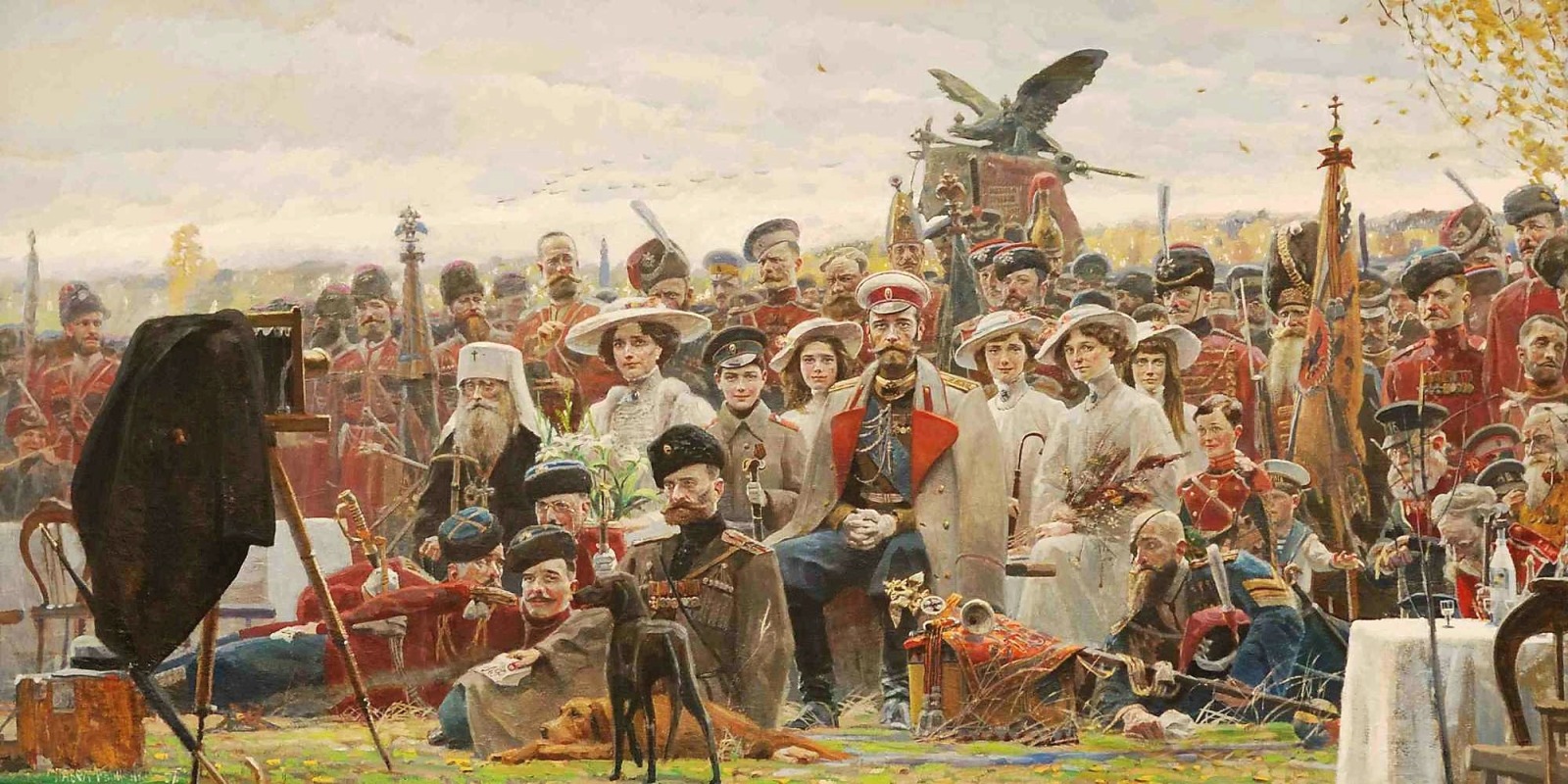
Creator: Valentin Serov (Valentin Alexandrovich Serov, 1865–1911)
Nationality: Russian
Notice who wrote the case against Nicholas. The portrait of the bumbling despot, the “Bloody Nicholas” of the textbooks, is very largely the work of the men who needed him guilty: the revolutionaries who had to justify murdering an anointed king and his children, and the Soviet historians who spent seventy years polishing the indictment. Before we accept their verdict, it is worth asking about the court that handed it down.
Take the charge that gave him the epithet. On Bloody Sunday in 1905, Nicholas was not at the Winter Palace. He was twenty-five miles away at Tsarskoye Selo, and he gave no order to fire. The troops were under other men’s command, and the fatal orders, so far as they can be traced, ran through his uncle and the city’s military officials, not through him. He learned of the deaths after the fact and set down his anguish over them in his diary. For this he was christened “the People’s Executioner” by a Marxist pamphleteer and “Bloody Nicholas” by the very movement that would soon kill more Russians in a single year than the whole Romanov line had in three centuries. That epithet is not a historical finding. It is a manufactured slander, repeated so long and so confidently that even his defenders have half swallowed it.
Now set the propaganda aside and look at the reign itself. Under Nicholas, Russia was not the frozen dungeon of the Soviet caricature but one of the fastest-growing economies on earth, industrializing at a furious pace, driving railways across a continent, multiplying its people, and raising literacy year on year. Stolypin’s reforms were turning peasants into property owners. The Russia the Bolsheviks seized was not a corpse waiting to be buried; it was a nation on the rise, which is precisely why they had to seize it rather than wait for it to fall into their hands.
And mark how it truly ended, because this is the part the textbooks smudge. The Bolsheviks never defeated Nicholas. They never beat him in the field, never won his people away from him in any fair contest, never once faced him as a ruler at all. By the time Lenin’s men took power that October, Nicholas had already been levered off the throne months earlier, in the February collapse, worn down by a total war and betrayed by the generals and parliamentarians who should have stood at his side. The Bolsheviks did not conquer a tsar. They inherited a prisoner, held him and his family under guard for a year, and then, losing their nerve as their enemies closed in, shot them in a basement. That is not how a regime behaves when it has won the argument. It is how men behave when the only victory left to them is over the unarmed.
Look instead at the man they had to erase to make room for their story. A devout Christian who worshipped without pretense. A husband faithful across thirty years of letters. A father who read Scripture to his children and meant every word of it; days before the end, the priest permitted to serve the liturgy for the family in their captivity came away shaken by the depth of their devotion. A sovereign who took personal command at the front when the war turned against him, and who in the end laid down his crown rather than keep it by drowning his country in civil blood. The failures that history has been taught to pin on him were the failures of an honest man dealt a hand no one could have played clean, and then knifed in the back by the very men sworn to help him hold it. Set his darkest hour beside the thing his murderers went on to build, and the comparison shames the asking. One was a good man who could not, in the end, save a civilization. The others unmade it on purpose, and called the ruin progress.
Passion-bearers

The Russian Orthodox Church later canonized the family, and the word it chose is worth pausing over. It did not, in the end, name them martyrs in the classic sense; they did not die for refusing to renounce Christ. It named them passion-bearers: those who meet an unjust death the way Christ met his, without hatred, without struggle, in meekness. It is a category the Christian imagination badly needs, and the Orthodox were right to reach for it here.
For there is a particular Christian witness that has nothing to do with winning. It is the witness of dying well, of being led down the stairs into the dark and carrying your faith with you rather than your fury. The family that spent its last full day in worship did not go down cursing. Whatever else the record is uncertain about, it is clear about that. There is a kind of strength the world has no category for, and the century that was about to begin would have less use for it than any before it.
What began in that cellar
Because the murders were not an ending. They were an overture.
The men in that basement were not settling a private score; they were enacting a philosophy, one that held that history moves by the liquidation of classes, that guilt is inherited by category, and that no inherited thing, no throne, no altar, no family, no God, was owed the slightest deference if it stood in the way of the future. The killing of the Romanovs was that philosophy’s early, intimate expression. What followed was the same logic at industrial scale: the terror, the famines, the camps, and beyond Russia the long grim procession of regimes built on the same premise, until the death toll of the whole project ran, by the most careful accounting, to the better part of a hundred million souls.
You cannot lay all of that at the feet of one night in Ekaterinburg. History is not a single thread you can pull. But it is fair to say that in that cellar you can see the thing distilled: the moment when a civilization’s oldest restraints, the ones that had said not the children, not the helpless, not this, were declared null by men who believed themselves at last free of them. That is what the Revolution was really offering the world: freedom from the inheritance. And the twentieth century is, in large part, the record of what men do when they get it.
Why I keep the memory
I read history through character and providence, and I am persuaded that the meekness of that family in the House of Special Purpose was a truer strength than the machinery that destroyed them. A hundred years on, it is the murdered father reading Scripture to his children who looks like the enduring thing, and the ideology that killed him that looks like the passing madness, for all the corpses it left in its wake.
So we remember: to keep faith with the murdered, to name the thing that murdered them, and to refuse the century’s central lie, that the past is only weight and that we would be freer without it. Some inheritances are the only thing standing between a family and the cellar.
Leave a Reply