Category: Culture

The visual, literary and performing arts, with some architecture thrown in.

  • A Dog Has Died

    BY PABLO NERUDA

    TRANSLATED BY ALFRED YANKAUER

    My dog has died.
    I buried him in the garden
    next to a rusted old machine.

    Some day I’ll join him right there,
    but now he’s gone with his shaggy coat,
    his bad manners and his cold nose,
    and I, the materialist, who never believed
    in any promised heaven in the sky
    for any human being,
    I believe in a heaven I’ll never enter.
    Yes, I believe in a heaven for all dogdom
    where my dog waits for my arrival
    waving his fan-like tail in friendship.

    Ai, I’ll not speak of sadness here on earth,
    of having lost a companion
    who was never servile.
    His friendship for me, like that of a porcupine
    withholding its authority,
    was the friendship of a star, aloof,
    with no more intimacy than was called for,
    with no exaggerations:
    he never climbed all over my clothes
    filling me full of his hair or his mange,
    he never rubbed up against my knee
    like other dogs obsessed with sex.

    No, my dog used to gaze at me,
    paying me the attention I need,
    the attention required
    to make a vain person like me understand
    that, being a dog, he was wasting time,
    but, with those eyes so much purer than mine,
    he’d keep on gazing at me
    with a look that reserved for me alone
    all his sweet and shaggy life,
    always near me, never troubling me,
    and asking nothing.

    Ai, how many times have I envied his tail
    as we walked together on the shores of the sea
    in the lonely winter of Isla Negra
    where the wintering birds filled the sky
    and my hairy dog was jumping about
    full of the voltage of the sea’s movement:
    my wandering dog, sniffing away
    with his golden tail held high,
    face to face with the ocean’s spray.

    Joyful, joyful, joyful,
    as only dogs know how to be happy
    with only the autonomy
    of their shameless spirit.

    There are no good-byes for my dog who has died,
    and we don’t now and never did lie to each other.

    So now he’s gone and I buried him,
    and that’s all there is to it.
  • If

    And—which is more—you’ll be a Man, my son!”

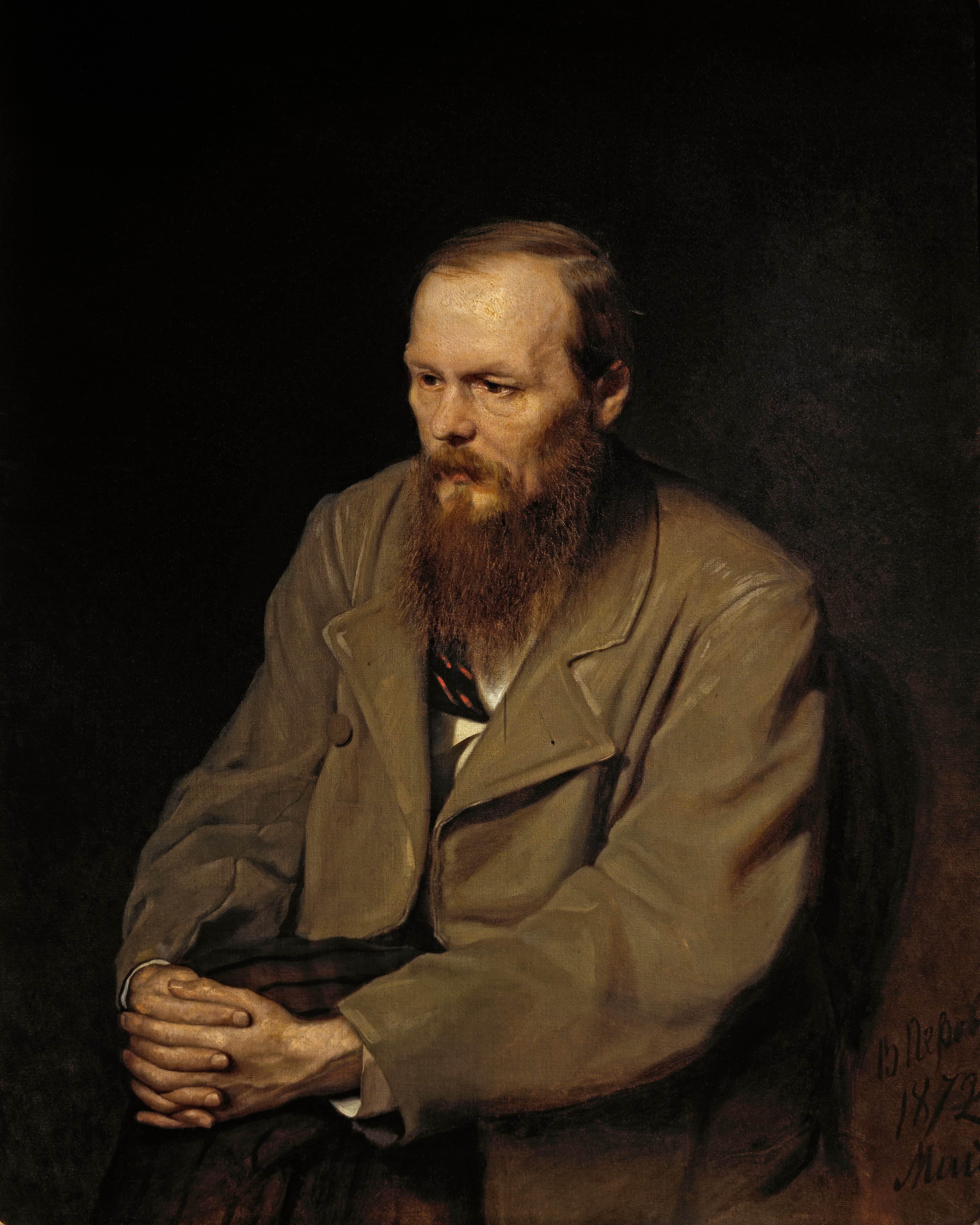
  • Beauty will save the world – Dostoevsky

    “One day Dostoevsky threw out the enigmatic remark: “Beauty will save the world”. What sort of a statement is that? For a long time I considered it mere words. How could that be possible? When in bloodthirsty history did beauty ever save anyone from anything? Ennobled, uplifted, yes – but whom has it saved?

    There is, however, a certain peculiarity in the essence of beauty, a peculiarity in the status of art: namely, the convincingness of a true work of art is completely irrefutable and it forces even an opposing heart to surrender. It is possible to compose an outwardly smooth and elegant political speech, a headstrong article, a social program, or a philosophical system on the basis of both a mistake and a lie. What is hidden, what distorted, will not immediately become obvious.

    Then a contradictory speech, article, program, a differently constructed philosophy rallies in opposition – and all just as elegant and smooth, and once again it works. Which is why such things are both trusted and mistrusted.

    In vain to reiterate what does not reach the heart.

    But a work of art bears within itself its own verification: conceptions which are devised or stretched do not stand being portrayed in images, they all come crashing down, appear sickly and pale, convince no one. But those works of art which have scooped up the truth and presented it to us as a living force – they take hold of us, compel us, and nobody ever, not even in ages to come, will appear to refute them.

    So perhaps that ancient trinity of Truth, Goodness and Beauty is not simply an empty, faded formula as we thought in the days of our self-confident, materialistic youth? If the tops of these three trees converge, as the scholars maintained, but the too blatant, too direct stems of Truth and Goodness are crushed, cut down, not allowed through – then perhaps the fantastic, unpredictable, unexpected stems of Beauty will push through and soar to that very same place, and in so doing will fulfil the work of all three?

    In that case Dostoevsky’s remark, “Beauty will save the world”, was not a careless phrase but a prophecy? After all he was granted to see much, a man of fantastic illumination.

    And in that case art, literature might really be able to help the world today?”
    — Aleksandr Solzhenitsyn (Nobel Lecture)

  • On the 400th Thanksgiving.

    The First Thanksgiving, 1621

    This is the 400th anniversary of the first Thanksgiving festival in the new world. Our ancestors landed here in 1620 and celebrated their first successful harvest in 1621.

    Jean Leon Gerome Ferris (August 8, 1863 – March 18, 1930) was an best known for his series of 78 scenes from , entitled The Pageant of a Nation, the largest series of American historical paintings by a single artist.

  • Hector and Andromache

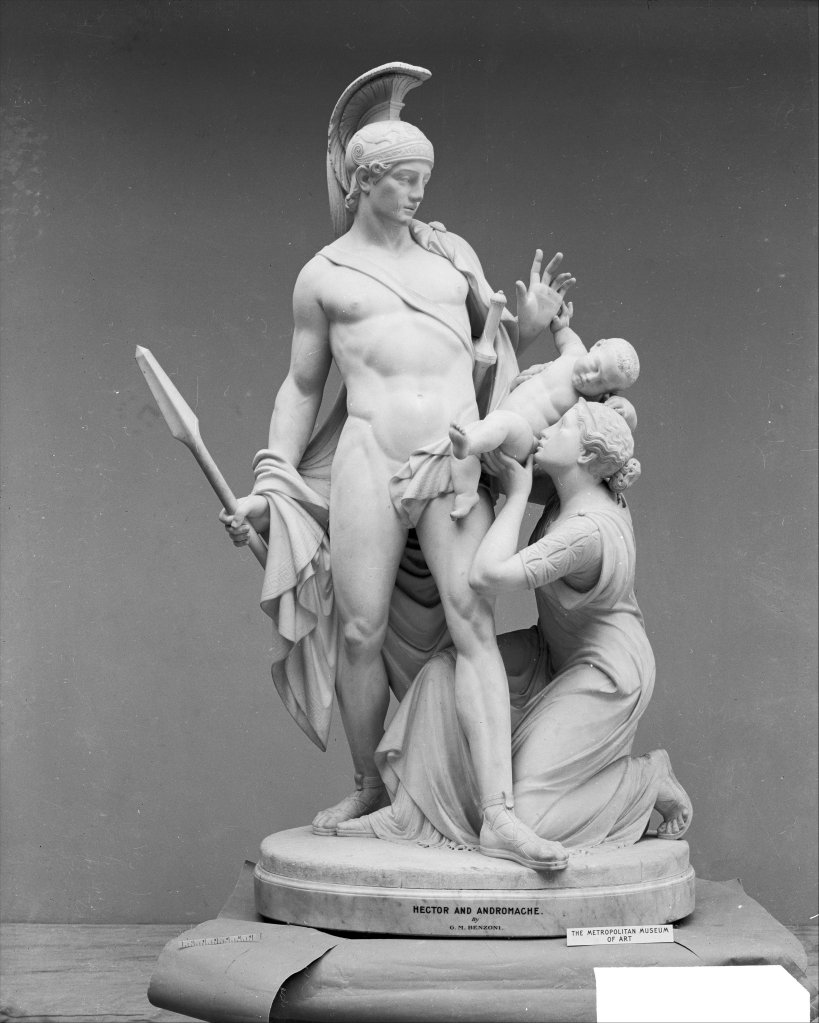
     Hector and Andromache by Giovanni Maria Benzoni 1871

    He stretched his arms towards his child, but the boy cried and nestled in his nurse’s bosom, scared at the sight of his father’s armour, and at the horse-hair plume that nodded fiercely from his helmet. His father and mother laughed to see him, but Hector took the helmet from his head and laid it all gleaming upon the ground. Then he took his darling child, kissed him, and dandled him in his arms, praying over him the while to Jove and to all the gods. “Jove,” he cried, “grant that this my child may be even as myself, chief among the Trojans; let him be not less excellent in strength, and let him rule Ilius with his might. Then may one say of him as he comes from battle, ‘The son is far better than the father.’ May he bring back the blood-stained spoils of him whom he has laid low, and let his mother’s heart be glad.’” – Iliad. Homer

  • Drooling David

    Drooling David

    11 And the servants of Achish said to him, “Is not this David the king of the land? Did they not sing to one another of him in dances,
    ‘Saul has slain his thousands, and David his ten thousands’?”

    12 And David took these words to heart, and was much afraid of Achish the king of Gath.

    13 So he changed his behavior before them, and feigned himself mad in their hands, and made marks on the doors of the gate, and let his spittle run down his beard.

    14 Then said Achish to his servants, “Lo, you see the man is mad; why then have you brought him to me?

    15 Do I lack madmen, that you have brought this fellow to play the madman in my presence? Shall this fellow come into my house?” – 1 Samuel 21; 11 – 15 RSV

  • How the world will come to an end

    “A fire broke out backstage in a theatre. The clown came out to warn the public; they thought it was a joke and applauded. He repeated it; the acclaim was even greater. I think that’s just how the world will come to an end: to general applause from wits who believe it’s a joke.” ― Soren Kierkegaard, Either/Or, Part I

    Fotografi efter blyantstegning udført ca. 1840 af N. C. Kierkegaard
  • Save your strength for better times to come.

    “My comrades, hardly strangers to pain before now, we all have weathered worse. Some god will grant us an end to this as well. You’ve threaded the rocks resounding with Scylla’s howling rabid dogs, and taken the brunt of the Cyclops’ boulders, too. Call up your courage again. Dismiss your grief and fear. A joy it will be one day, perhaps, to remember even this. Through so many hard straits, so many twists and turns our course holds firm for Latium. There Fate holds out a homeland, calm, at peace. There the gods decree the kingdom of Troy will rise again. Bear up. Save your strength for better times to come.” ― Virgil, The Aeneid

    Aeneas and the Sibyl – Unknown
  • Romulus and Remus

    The Shepherd Faustulus Bringing Romulus and Remus to His Wife, Nicolas Mignard (1654)

    Nicolas Mignard, called Mignard d’Avignon, (7 February 1606 (baptised) – 20 March 1668) was a French painter known for his religious and mythological scenes and portraits. He spent most of his active life in Avignon creating religious and mythological paintings for religious institutions and stately homes but ended his career as court painter in Paris.
  • Language

    Language

    Language belongs to man’s property, to his nature, his patrimony, and his patria, and it comes to him innocently, without him realizing its bounteousness and wealth. Language is more than a garden whose heirs will be refreshed by its flowers and fruits long into old age; it is also one of the great forms for all goods in general. As light makes the world and its forms visible, so language makes their inner nature comprehensible and is indispensable as a key to their treasures and secrets.

    Ernst Jünger, The Forest Passage