“A fire broke out backstage in a theatre. The clown came out to warn the public; they thought it was a joke and applauded. He repeated it; the acclaim was even greater. I think that’s just how the world will come to an end: to general applause from wits who believe it’s a joke.” ― Soren Kierkegaard, Either/Or, Part I
Fotografi efter blyantstegning udført ca. 1840 af N. C. Kierkegaard
“My comrades, hardly strangers to pain before now, we all have weathered worse. Some god will grant us an end to this as well. You’ve threaded the rocks resounding with Scylla’s howling rabid dogs, and taken the brunt of the Cyclops’ boulders, too. Call up your courage again. Dismiss your grief and fear. A joy it will be one day, perhaps, to remember even this. Through so many hard straits, so many twists and turns our course holds firm for Latium. There Fate holds out a homeland, calm, at peace. There the gods decree the kingdom of Troy will rise again. Bear up. Save your strength for better times to come.” ― Virgil, The Aeneid
Nicolas Mignard, called Mignard d’Avignon, (7 February 1606 (baptised) – 20 March 1668) was a French painter known for his religious and mythological scenes and portraits. He spent most of his active life in Avignon creating religious and mythological paintings for religious institutions and stately homes but ended his career as court painter in Paris.
Language belongs to man’s property, to his nature, his patrimony, and his patria, and it comes to him innocently, without him realizing its bounteousness and wealth. Language is more than a garden whose heirs will be refreshed by its flowers and fruits long into old age; it is also one of the great forms for all goods in general. As light makes the world and its forms visible, so language makes their inner nature comprehensible and is indispensable as a key to their treasures and secrets.
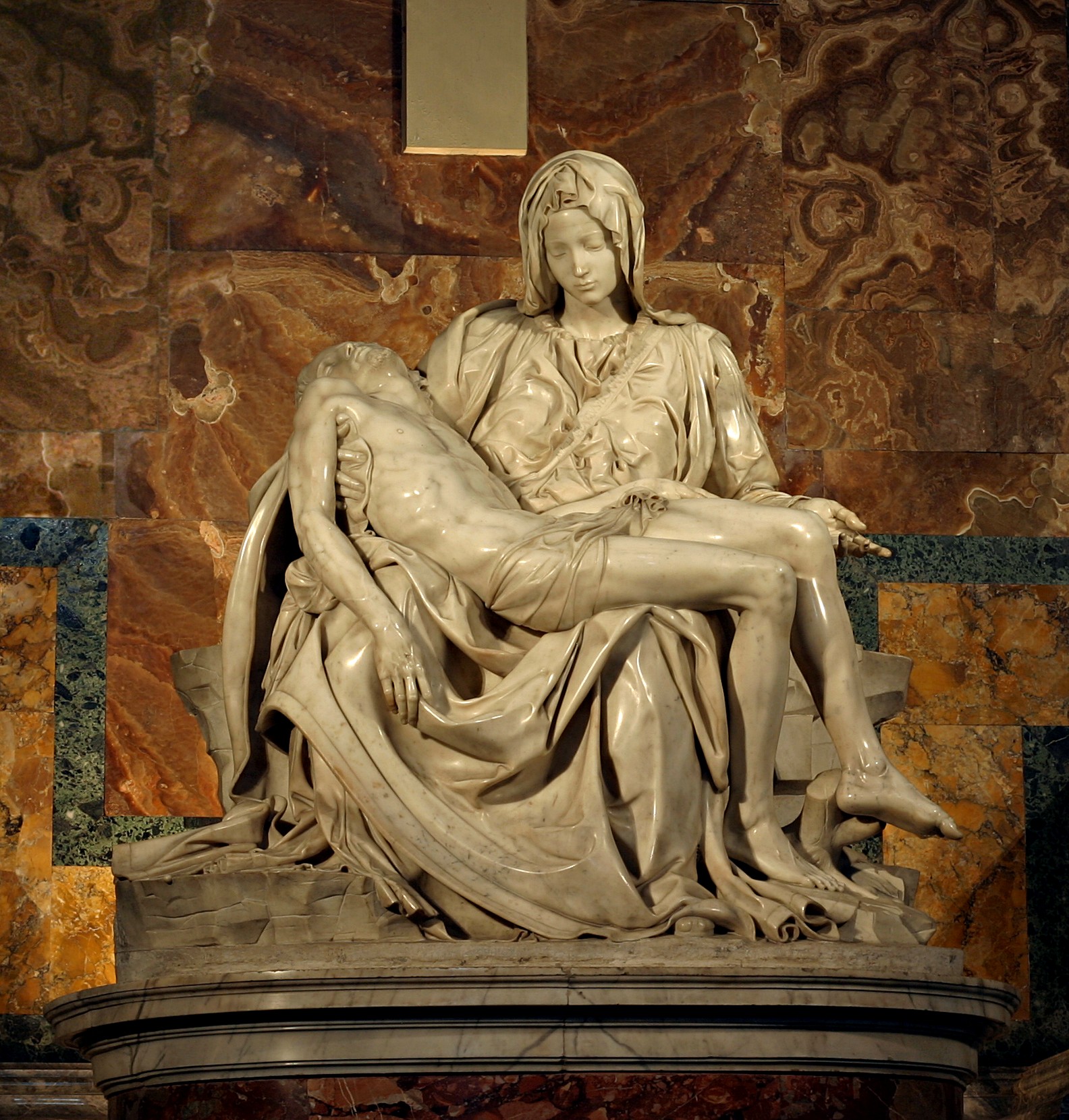
The Pietà is a work of Renaissance sculpture by Michelangelo Buonarroti, housed in St. Peter’s Basilica, Vatican City. It is the first of a number of works of the same theme by the artist. The statue was commissioned for the French Cardinal Jean de Bilhères, who was a representative in Rome. The sculpture, in Carrara marble, was made for the cardinal’s funeral monument, but was moved to its current location, the first chapel on the north side of the entrance of the basilica, in the 18th century. It is the only piece Michelangelo ever signed. It is also the only known sculpture created by a prominent name from the Renaissance era that was installed in St. Peter’s Basilica that was accepted by the Chapter of St. Peter. This famous work of art depicts the body of Jesus on the lap of his mother Mary after the Crucifixion.
Giovanni Battista Salvi da Sassoferrato (August 25, 1609 – August 8, 1685), also known as Giovanni Battista Salvi, was an Italian Baroque painter, known for his archaizing commitment to Raphael’s style. He is often referred to only by the town of his birthplace (Sassoferrato), as was customary in his time, and for example seen with da Vinci and Caravaggio.
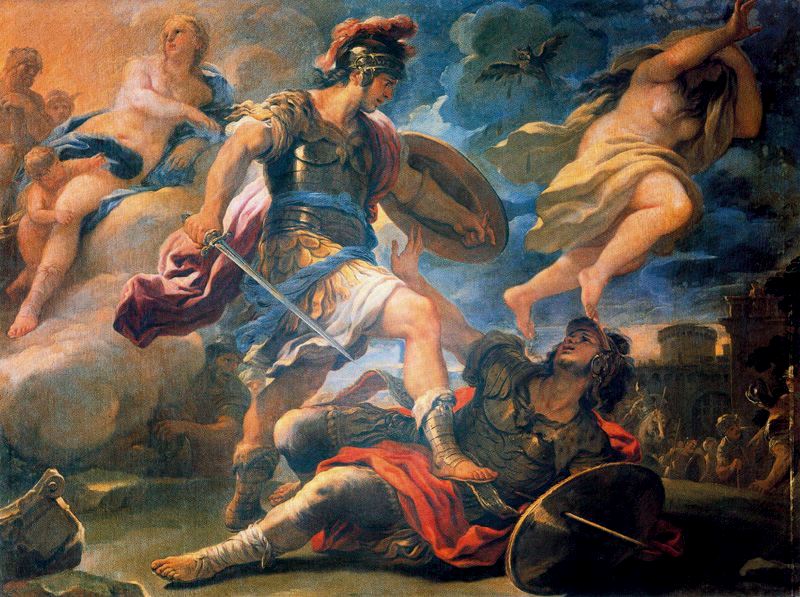
Turnus (Ancient Greek: Τυρρηνός, romanized: Tyrrhênós) was the legendary King of the Rutuli in Roman history, and the chief antagonist of the hero Aeneas in Virgil’s Aeneid. According to the Aeneid, Turnus is the son of Daunus and the nymph Venilia and is brother of the nymph Juturna.
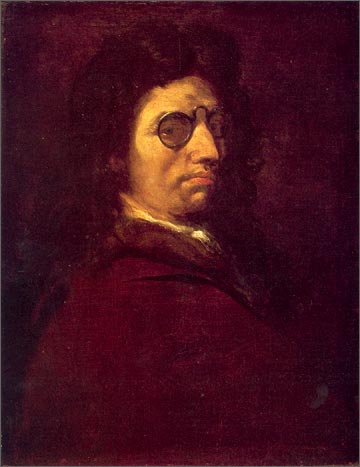
Luca Giordano (18 October 1634 – 3 January 1705) was an Italian late Baroque painter and printmaker in etching. Fluent and decorative, he worked successfully in Naples and Rome, Florence and Venice, before spending a decade in Spain.
Dome of the central rotunda lined with statues of the Muses in the Gould Memorial Library at Bronx Community College. The architect, Stanford White (1853-1906), was inspired by the Roman Pantheon.
Beauty at the Bronx Community CollegeThe library of Bronx Community College, designed by architect Stanford White, shown in 1904 when the campus was part of New York University; the Hall of Fame for Great Americans arcade is visible to the left and right of the libraryBrutalism at the Bronx Community College
Böcklin’s original training as a landscape painter shines through in this unconventional interpretation of an episode from the ancient Greek epic poem the Odyssey. Crashing waves meet jagged rocks in a spray and scurry of foam. Escaping from the island of the Cyclopes—one-eyed, ill-tempered giants—the hero Odysseus calls back to the shore, taunting the Cyclops Polyphemus, who heaves a boulder after the boat. Unlike Academic colleagues who treated ancient mythology with reverence and solemnity, Böcklin often played up strange, grotesque, and even ridiculous elements of these stories, conjuring a pre-Classical world governed by violence and lust.
Charon, the ferryman of the dead in Greek mythology, shown in this nineteenth-century painting by Alexander Litovchenko.
In Greek mythology and Roman mythology, Charon or Kharon is a psychopomp, the ferryman of Hades who carries souls of the newly deceased across the river Styx that divided the world of the living from the world of the dead. A coin to pay Charon for passage, usually an obolus or danake, was sometimes placed in or on the mouth of a dead person. Some authors say that those who could not pay the fee, or those whose bodies were left unburied, had to wander the shores for one hundred years, until they were allowed to cross the river.
Alexander Dmitrievich Litovchenko was a Ukrainian-born Russian painter who specialized in depicting Muscovite Russia of the 16th and 17th centuries.