Guido Reni’s Michael (in Santa Maria della Concezione church, Rome, 1636) tramples Satan. A mosaic of the same painting decorates St. Michael’s Altar in St. Peter’s Basilica.
Michael is an archangel mentioned three times in the Book of Daniel.
In the New Testament, Michael leads God’s armies against Satan’s forces in the Book of Revelation, where during the war in heaven he defeats Satan. In the Epistle of Jude, Michael is specifically referred to as “the archangel Michael”. Sanctuaries to Michael were built by Christians in the 4th century, when he was first seen as a healing angel. Over time his role became one of a protector and the leader of the army of God against the forces of evil. https://en.wikipedia.org/wiki/Michael_(archangel)
“Since it is so likely that (children) will meet cruel enemies, let them at least have heard of brave knights and heroic courage. Otherwise you are making their destiny not brighter but darker.”
King Lear and the Fool in the Storm by William Dyce
William Dyce 19 September 1806 in Aberdeen – 14 February 1864) was a Scottish artist, who played a part in the formation of public art education in the United Kingdom, and the South Kensington Schools system. (Wikipedia)
King Lear is a tragedy written by William Shakespeare. It tells the tale of a king who bequeaths his power and land to two of his three daughters, after they declare their love for him in a fawning and obsequious manner. His third daughter gets nothing, because she will not flatter him as her sisters had done. When he feels he has been treated with disrespect by the two daughters who now have his wealth and power, he becomes furious to the point of madness. He eventually becomes tenderly reconciled to his third daughter, just before tragedy strikes her and then the king. (Wikipedia)
“We shall soon be in a world in which a man may be howled down for saying that two and two make four, in which people will persecute the heresy of calling a triangle a three-sided figure, and hang a man for maddening a mob with the news that grass is green.” – G.K. Chesterton
In the end the Party would announce that two and two made five, and you would have to believe it. It was inevitable that they should make that claim sooner or later: the logic of their position demanded it. Not merely the validity of experience, but the very existence of external reality, was tacitly denied by their philosophy. The heresy of heresies was common sense. And what was terrifying was not that they would kill you for thinking otherwise, but that they might be right. For, after all, how do we know that two and two make four? Or that the force of gravity works? Or that the past is unchangeable? If both the past and the external world exist only in the mind, and if the mind itself is controllable what then? – George Orwell, Nineteen Eighty-Four
That All is not Gold that Glitters, and Two and Two make Four— Rudyard Kipling
Prometheus Brings Fire to Mankind (c. 1817) by Heinrich Füger
Cover thy spacious heavens, Zeus, With clouds of mist, And like the boy who lops The thistles’ heads, Disport with oaks and mountain-peaks; Yet thou must leave My earth still standing; My cottage, too, which was not raised by thee; Leave me my hearth, Whose kindly glow By thee is envied.
I know nought poorer Under the sun, than ye gods! Ye nourish painfully, With sacrifices And votive prayers, Your majesty; Ye would e’en starve, If children and beggars Were not trusting fools.
While yet a child, And ignorant of life, I turned my wandering gaze Up toward the sun, as if with him There were an ear to hear my wailings, A heart, like mine, To feel compassion for distress.
Who helped me Against the Titans’ insolence? Who rescued me from certain death, From slavery? Didst thou not do all this thyself, My sacred glowing heart? And glowedst, young and good, Deceived with grateful thanks To yonder slumbering one?
I honour thee, and why? Hast thou e’er lightened the sorrows Of the heavy laden? Hast thou e’er dried up the tears Of the anguish-stricken? Was I not fashioned to be a man By omnipotent Time, And by eternal Fate, Masters of me and thee?
Didst thou e’er fancy That life I should learn to hate, And fly to deserts, Because not all My blossoming dreams grew ripe?
Here sit I, forming mortals After my image; A race resembling me, To suffer, to weep, To enjoy, to be glad, And thee to scorn, As I!
“The Barbarian hopes — and that is the mark of him, that he can have his cake and eat it too.He will consume what civilization has slowly produced after generations of selection and effort, but he will not be at pains to replace such goods, nor indeed has he a comprehension of the virtue that has brought them into being. Discipline seems to him irrational, on which account he is ever marvelling that civilization, should have offended him with priests and soldiers…. In a word, the Barbarian is discoverable everywhere in this, that he cannot make: that he can befog and destroy but that he cannot sustain; and of every Barbarian in the decline or peril of every civilization exactly that has been true.
We sit by and watch the barbarian. We tolerate him in the long stretches of peace, we are not afraid. We are tickled by his irreverence; his comic inversion of our old certitudes and our fixed creed refreshes us; we laugh. But as we laugh we are watched by large and awful faces from beyond, and on these faces there are no smiles.”
― Hilaire Belloc
Joseph Hilaire Pierre René Belloc (27 July 1870 – 16 July 1953) was a British-French writer and historian and one of the most prolific writers in England during the early twentieth century. Belloc was also an orator, poet, sailor, satirist, writer of letters, soldier, and political activist. His Catholic faith had a strong impact on his works. He was President of the Oxford Union and later MP for Salford from 1906 to 1910. He was a noted disputant, with a number of long-running feuds. Belloc became a naturalised British subject in 1902 while retaining his French citizenship.
His writings encompassed religious poetry and comic verse for children. His widely sold Cautionary Tales for Children included “Jim, who ran away from his nurse, and was eaten by a lion” and “Matilda, who told lies and was burned to death”. He also collaborated with G. K. Chesterton on a number of works.
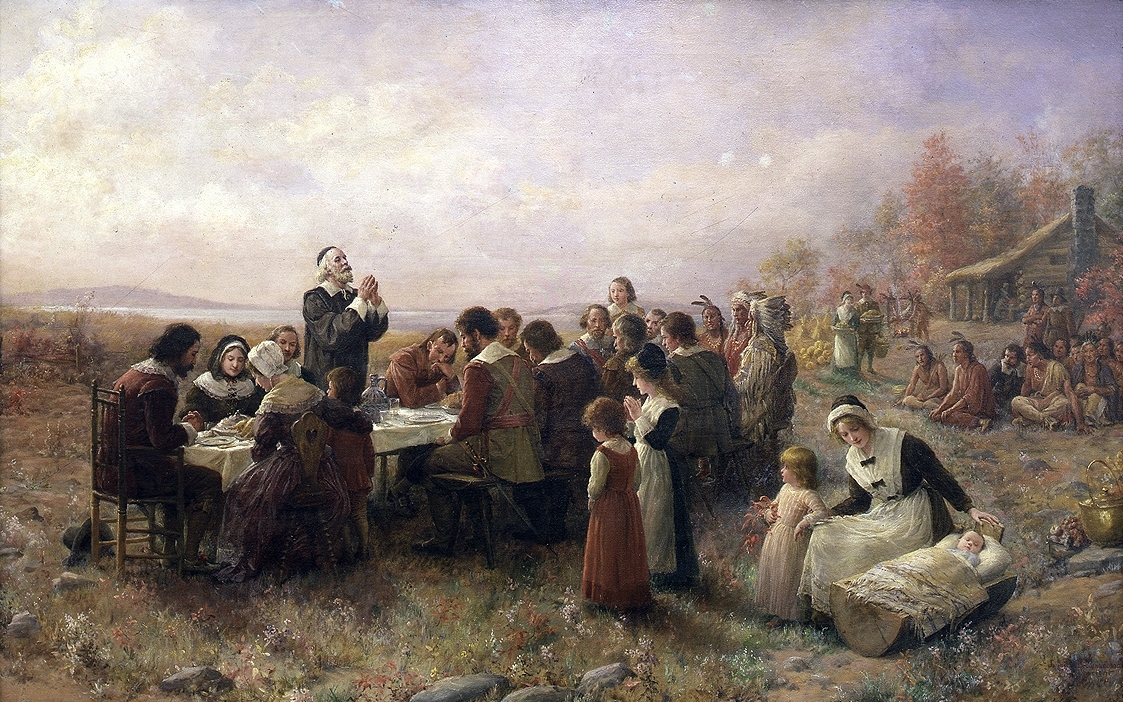
Jennie Augusta Brownscombe (December 10, 1850 – August 5, 1936) was an American painter, designer, etcher, commercial artist and illustrator. Brownscombe studied art for years in the United States and in Paris. She was a founding member, student and teacher at the Art Students League of New York. She made genre paintings, including revolutionary and colonial American history, most notably The First Thanksgiving held at Pilgrim Hall in Plymouth, Massachusetts. She sold the reproduction rights to more than 100 paintings, and images of her work have appeared on prints, calendars and greeting cards. Her works are in many public collections and museums. In 1899 she was described by New York World as “one of America’s best artists.”